Category Archives: Uncategorized

Bruce Reynolds: In His Own Words

Unknown

When Bruce Reynolds had finished the manuscript of my novel Signal Red, he asked if he could pen a postscript ‘just to set the record straight’. This is what he gave me, written in a shaky hand from his sick bed (he had flu) on foolscap paper. It can be found in the end pages of the novel.

“A Glasgow to London mail train was stopped and robbed in Buckinghamshire early today. It happened at Cheddington, near Tring, at about 3am. The driver and the fireman were attacked and injured and two coaches of the train were detached. They contained mail of all kinds, including registered post, said a police spokesman a short time ago. It is believed a large number of men took part and that they got away with a considerable amount of cash. Neither the driver nor the fireman was seriously injured. Senior officers of Buckinghamshire police are now at the scene.”

Above is the original transcript of the BBC’s first radio broadcast concerning the theft from the Royal Mail of 2.6 million in used notes on August 8, 1963. It was initially known at The Cheddington Mail Train Robbery, but this was deemed not snappy enough. Instead, they lifted the title of The Great Train Robbery from an American film dating back to 1903. With massive public interest in the event, the authorities became angry and agitated. There were questions in Parliament, with the reverberations spreading through the country and across the globe like a distant but persistent drumbeat. The words echoed down the corridor of power: ‘They must be caught and convicted’.
So, the police were given carte blanche, and the ‘big boys’ called in, notably the Flying Squad, with Tommy Butler as the Thieftaker General. It was a job he was admirably suited for, as he remarked with conviction to his colleague ‘Nipper’ Read: ‘We’ll get the bastards.’ The hunt was on.
Rumours were rife. Informed sources said the organiser of the robbery was an ex-commando, Major Johnny Rainbow; others claimed that Billy Hill, the self-proclaimed King Of The Underworld, was involved. Both wrong, of course. Names were bandied about, reputations besmirched, with plenty of winners and losers in the media frenzy that surrounded the robbery. The biggest losers, of course, were the men who robbed the train.
None of the actual robbers appreciated the full consequences of their actions; it only became apparent at a later date just how determined the authorities were. The scale of the manhunt, the size rewards offered and, especially, the eventual sentences were all unprecedented. Thirty years was unheard of, even for terrorist bombers.
But ‘stone walls don’t a prison make, nor iron bars a cage’. And so it proved. Charlie Wilson and Ronnie Biggs refused to accept their dire situation and promptly escaped. The media revelled in this turn of events and the hunt stepped up a gear. As did the whole story of The Great Train Robbery, which went through peaks and troughs of public interest, subsiding when the chase went quiet, thrusting its way back into the limelight with Ronnie’s rip-roaring adventures in Rio. The public applauded this cheeky chappy, their emotions switching from curiosity, through admiration to envy: who wouldn’t want to live a free and easy life adjacent to Copacabana in Rio?
The story has been told many times now, but continues to fascinate the media and readers, perhaps because it ‘all begins with intrigue and ends in mystery’.
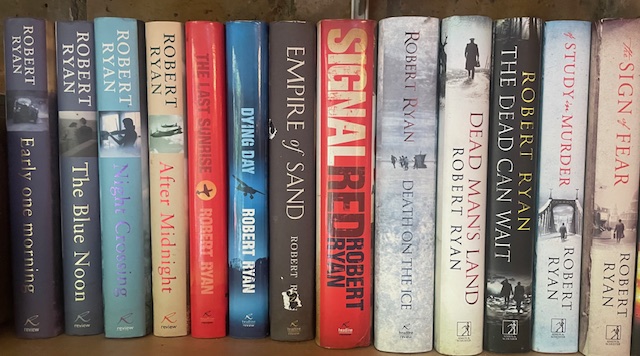
Now, Robert Ryan has fictionalised the tale based on known facts but using imagined situations and dialogue, a technique he has used before in his novel Death on the Ice, about Captain Scott, and with Lawrence of Arabia in Empire of Sand. They were both key characters from my boyhood days, which is what attracted me to his work. The story he tells in SIGNAL RED is impeccably researched and the salient facts are all there. However, for his characterisation he had to rely on contemporary accounts, memoirs, other writers’ descriptions and conclusions (many of the major figures on both sides of the law being deceased) and his own interpretations, and that doesn’t always fit into my own memories of some of the personalities.
That is not to say he is wrong. In fact, he could be correct. At the time I might well have been blinkered: the light that he shines illuminates some dark corners whilst throwing shadows on others. But while my memory and his version don’t always see eye-to-eye, he captures the times perfectly and particularly the essence of camaraderie which existed and flourished under the banner of crime, specifically robbery. When a group of men embark on a nefarious series of enterprises that will, almost certainly, see some of them in prison, losing everything, then your relationship with your fellow robbers become the most important element of the undertaking. Being able to trust them is of paramount importance (and remember, none of the robbers turned Queen’s Evidence or co-operated with the police in any way).
Ultimately, as a robber, you are facing losing your freedom, but I don’t think you fully appreciate what this means until it is taken away from you. That realisation comes too late, even though you are aware every time you go to ‘work’, it might be your last job. The mind plays tricks on you anyway, about the consequences of your action and the chances of being caught. Is it worth the risk? you might ask yourself. But if you’re a grafter, you’ll dismiss the risk factor and go for the adrenaline. That’s the addiction.
True, old-fashioned greed is also a motivating factor, whether it is for money, power or reputation. I guess we all craved one or more of those categories, and some of us embraced them all. Upon reflection, I realise that I never, at the time of the robbery, questioned people’s motivation for being ‘at it’. In fact, I hardly know them now.
Charlie Wilson lived in the next street to mine in Battersea and we went to school together. He was younger than me, and we were pals without being bosom buddies. I only really got to know him in his twenties. In my eyes, he never changed: always cheerful, game for a lark and totally reliable. A very sound man.
I was shocked to hear of Charlie’s death, shot by the side of his swimming pool at his home in Marbella, evoking the end of Gatsby. The theft of his life only led to retribution and further theft of lives. The moral there is, no matter how big you are, there is always someone bigger and with more power.
Charlie was buried in Earlsfield, local to us Battersea Boys. The service closed with a final flourished of bravado, as the coffin was accompanied by Sinatra doing his version on My Way. That was Chas all right.
Roy James had one ambition when he received his 30-year sentence: to get out of prison and pursue his motor racing career to his ultimate aim, becoming World Champion. He embraced Seneca and the Stoics’ principals, as defined by prison doggerel: ‘If you can’t do the time, don’t do the crime’, or my favourite ‘Eat your porridge every day and do your bird the easy way.’
Nice constructive sentiments, but nobody serves a decade inside without physical and mental damage. In spite of Roy’s pursuit of his physical fitness, something had gone when he finally got out. He transferred his ambitions in other directions, and was very successful financially, but perhaps less so emotionally. He had a long-term relationship that broke up and eventually ended up marrying a younger woman and fathered two daughters. It appeared he had made it. He had the country house, complete with ponies and stables, an attractive young wife and lovely girls. But somehow, it was not enough. Nothing satisfied him. Probably because the grand ambition – to win the World Championship – was lost and gone forever.
What caused his confrontation with his wife and father-in-law and the events that followed is a mystery, yet such events are all too common in the real world of domestic discord. Ignominiously Roy (forever saddled with the media-invented, or at least media-popularised, nickname of The Weasel, which he hated) went back to prison.
Inside, his physical condition declined. He had seen Bill Boal – innocent of the crime, yet convicted – die inside. He had seen Biggsy kidnapped from Brazil and promptly stolen back by Brazil. He had seen Buster’s tragic suicide. He must have asked himself, as most of us of a certain age do – what is it all about?
He died in hospital of a heart attack. He was 62.
Roy’s mantra was best expressed as pitting yourself against the world, going to the extreme to see if you can hack it. Will you match up? It’s a hard code to live by. There is a consolation: I now know you don’t recognise success unless you have first experienced abject failure. Your ambition to drive to the edge of the abyss, to seek the impossible and make it possible, certainly invites failure. But if you do fail, it’s an honourable failure.

Bruce Reynolds, author of Autobiography of A Thief (Virgin Books)
A review from Kirkus

The action moves from England to northern France in Robert Ryan’s Dead Man’s Land. It’s 1918, and Dr. John H. Watson—following an emotional split from Sherlock Holmes—has been commissioned as a

major with the Royal Army Medical Corps. Though now in his mid-60s, he’s been dispatched to the deadly front lines as “an expert in the new techniques of blood transfusion.” In the face of persistent shellings and unrelenting carnage, Watson feels satisfaction in helping the war effort. Yet it’s his skills as a sleuth as much as a surgeon that come in handy here.

homepic1

After a British soldier perishes from a bizarre ailment that turns his skin blue and his hands into claws, Watson’s transfusion techniques fall under suspicion. He’s convinced, though, that another explanation exists. So when a similar death does occur, Watson starts digging into the victims’ history, looking for connections between them. He’s aided in this effort by a volunteer nurse with the Red Cross, the resourceful Georgina Gregson, whose past clashes with the law may make her an unreliable ally. As the violence of war swirls about their heads, and snipers keep a lethal vigil in the bleak no-man’s-land between opposing armies, Watson pursues a murderer with old grudges and no compunction against adding Holmes’ onetime chronicler to the count of battlefront casualties.

Author Ryan’s depiction of combat-zone privations and the peculiar society of the trenches radiates with authenticity, and his portrayal of Dr. Watson is sufficiently faithful to have won Dead Man’s Land the authorization of Sir Arthur Conan Doyle’s estate. I understand a sequel is already in the pipeline. Perhaps by then, this UK release will have found a U.S. publisher. Fortunately, it’s easily available now from online sources.

J. Kingston Pierce is both the editor of The Rap Sheet and the senior editor of January Magazine.

THE ELK AND THE OYSTER: EATING IN W. SWEDEN

Gothenburg is, so they told me, much like my home town of Liverpool – a once thriving port, with its own dialect, music scene and quirky sense of humour. I forgot to ask if it had an underperforming football team, too. But I wasn’t there for similarities, I was there for differences. Unlike Liverpool, Gothenburg is somewhere you go for great food, especially seafood and it is perfectly positioned geographically and culturally to take advantage of the current thirst for all things Nordic and locavore. I was here to eat.

If you want to see the legendary Gothenburg bounty from the sea, you visit Feskekörka – the Fish Church, which really does look like a Piscean house of worship  – market on the riverside, where the downturned mouths and black-button eyes of dozens of marine species stare back at you from their marble resting places. Better yet, you climb the stairs to the mezzanine level, where tiny Restaurant Gabriel (00 46 31 139051, restauranggabriel.com, lunch only, approx £30pp) takes the produce from the slabs below and cooks it as simply as possible – if at all.

gabriellogo

Chef Johan Malm won the World Oyster Opening Championship in Galway in 2010 (and came a close second in 2012) and he apologises profusely that he has no Swedish bivalves to offer me, blaming ‘lazy divers’ (all Swedish oysters are hand-harvested and, in fact, there have been storms). Instead, he serves up six fat French numbers and a perfectly poached piece of hake. ‘People don’t really believe this, but our menu is just a guide. If you see a fish you want downstairs, tell me how you would like it cooked, I’ll buy it and I’ll do it. It’s as close as you can get to eating straight from the sea.’

The best way to get to Ulf Wagner and Gustav Trägardh’s Sjömagsinet (Adolf Edelsvärds gta 5, 00 46 31 7755920, sjomagsinet.se) is to take a trip on that sea, or at least along the river towards the sea, out past the fish market, the giant Stena ferries and the new waterfront developments to Klippen. Here, in an old East India Co. warehouse, is a very different take on using the local produce.

c161b7b5369b9a26299478fcd1073cd1_232x200

Sjömagsinet is unashamedly fancy food, not so much in the cooking techniques – there’s no molecular trickery – but in the combination of flavours. So expect baked anglerfish with chipotle jus, ragout of piglet shank and black salsify or saddle of venison with oyster vinaigrette. It was Ulf who told me that Gothenburg has the best seafood on the planet. At Sjömagsinet the meat’s pretty damn’ good too. A set menu is around £65; matching wines doubles that.

It is a long way from hip and heaving Harlem to nature-loving Gothenburg – the nearby archipelago is one of the city’s great attractions – but for Jimmy Lappalainen it is a homecoming. Born in a small village up the coast, as a young cook he went to New York and managed to secure a position with Marcus Samuelsson (Ethiopian born, Swedish-raised in Gothenburg, American culinary star), who opened the ground-breaking Red Rooster up at 125th St, Harlem in 2010, with Jimmy as chef. When Samuelsson was invited to oversee the restaurants at the new Clarion Hotel Post in Gothenburg, he brought Jimmy with him to be Executive Chef in situ (Samulesson pops over from Harlem every other month), although he has since moved up to be overall Food & Beverage manager for the hotel. ‘Obviously I’ve shipped some of New York back with me, too,’ he says. Not least in the scale of the room, which feels like a NYC public building.

norda_logo

The hotel is a new-ish (opened January 2012) conversion of the grand old city post office, and Norda (00  46 31 619060, nordabargrill.se), its restaurant, is located in the former postal hall, all soaring pillars and panelled ceilings, draped with great swathes of deep red curtains, giving it a vast, theatrical feel. The food is Swedish with an American twist – the classic hot dog is still in a bun, but it’s a wild boar sausage in brioche with home cured pickles (£12), or there’s elk carpaccio with maple syrup (£15). And, again, there is very good plain seafood: ‘Some things you just let talk for themselves,’ says Jimmy. And the oysters all say: ‘eat me’.

GETTING THERE: SAS (0871-226 7760, flysas.com) flies to Gothenburg from Heathrow. The Clarion Hotel Post (00 46 31 61 90 00, clarionpost.com) has doubles from £130, room only.

FURTHER INFORMATION: Visit Sweden (www.visitsweden.com) and Gothenburg (www.gothenburg.com).

NO BENJAMIN BRITTEN MUSIC WAS HARMED DURING THE MAKING OF THIS PROJECT

A couple of years ago Guy Barker took dZf, his 75-minute jazz-noir-suite loosely based on The Magic Flute libretto, to Aldeburgh.  It was performed at Snape Maltings, Benjamin Britten’s spiritual and musical home, with, as always, Michel Brandon narrating my script. It must have gone down well because the Aldeburgh Music people asked Guy to come back and do something similar for the centenary of Britten’s death. But what? Guy asked me to come up with some ideas for a narrative. After all, Britten used outside sources as inspiration – Herman Melville for Billy Budd, Henry James for Turn of the Screw, Thomas Mann, John Dowland, John Donne, Shakespeare, for other works. At first I thought about something to do with the piece BB wrote for POWs in Germany (see below), but neither Guy nor I could detect a jazz component in there. Guy and I have long been fascinated by Geraldo’s Navy, the jazzers who worked on the transatlantic ships in the ‘40s and ‘50s, who played strict dance tempo on board, but once in New York sought out Bird, Dizzy, Bud, Max and other beboppers. That combo of America, the sea (both an integral part of the BB story), British dance bands and the gradual absorption of the new music from across the Atlantic, gave us a starting point. It now forms the overture to a piece called That Obscure Hurt, based on a Henry James short story (Britten used two of his supernatural tales, we’re completing the trilogy) called the Jolly Corner – a misnomer if ever there was one – about the homecoming of a New York businessman after an absence of many years who finds his old house haunted by a monstrous presence. Having set dZf in New York, we decided that this piece should be centered on London. So the action has shifted to Soho, but the premise is the same as James’s original – a man who haunts himself. Now with added CCTV cameras. And, although initially I suggested there be no spoken word and no songs, it looks like we are having both. Yup, it’s in great danger of turning into a jazz-opera with ghosts. One thing we can promise: as with Mozart and dZf, no music by Benjamin Britten will be harmed in this project.608

STOP PRESS: The BBC Concert Orchestra today announced the appointment of composer, arranger and jazz trumpeter Guy Barker as its new Associate Composer. The position, previously held by Radiohead guitarist Jonny Greenwood and the Art of Noise’s Anne Dudley, will be for an initial period of two years beginning in April 2013. http://www.bbc.co.uk/mediacentre/latestnews/2013/bbccoguybarker.html

THE WRONG MAN

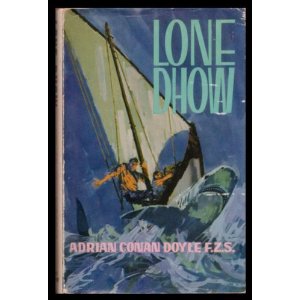
Don’t ever buy second-hand books with a New Year’s Day hangover. Wondering around a local used bookshop with my eyes narrowed against the punishing light, I came across what I thought was a true-life adventure by Sir Arthur Conan Doyle called Lone Dhow. When I got home, my eyes focussed a little better and I saw it was by ADRIAN Conan Doyle, ACD’s son by his second wife Jean. Lone Dhow is a tale about trying to capture a live tiger shark for the University of Geneva and there517DDydHxOL._SL500_AA300_ is something rather self-regarding about the tone. Certainly ACD’s biographer Andrew Lycett is less than complimentary about Adrian, calling him ‘a spendthrift playboy…who used the Conan Doyle estate as a milch-cow’. Adrian wrote a volume of Holmes stories (apparently with the help of John Dickson Carr), published as The Exploits of Sherlock Holmes, and established a replica of Holmes’s 221b at his home in Switzerland. Some of the tales are rather stilted but the best match the quality of his father’s later tales. There is an interesting interview by a young Joan Bakewell Adrian with on You Tube that includes him driving his Lamborghini and showing off his medieval castle and its Holmes’s shrine: http://www.youtube.com/watch?v=THtIleV3sfg

THE CASE OF THE EARLY ADOPTER

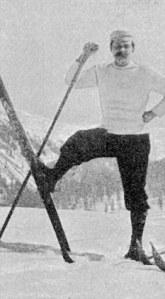
I have a piece in this weekend’s Sunday Times Travel on skiing (very badly) in Arosa in Switzerland. I was drawn to the resort partly because at the time I was writing Dead Man’s Land, featuring Dr Watson, and I knew Sir Arthur Conan Doyle had put Arosa on the map. The author was a keen sportsman and when he was staying at Davos (for his wife’s health) he ordered skis from Norway and set about teaching himself the discipline. As he wrote in The Strand magazine in 1894 “You let yourself go, gliding delightfully over the gentle slopes, flying down the steeper ones, taking an occasional cropper, but getting as near to flying as any earthbound man can. In that glorious air it is a delightful experience.’”

He was soon good enough to attempt the treacherous crossing over the Maienfelder Furka pass linking Davos to Arosa, which he did in the company of two local guides (the Branger Brothers). “But now we had a pleasure which boots can never give,” he wrote, “For a third of a mile we shot along over gently dipping curves, skimming down into the valley without a motion of our feet.  In that great untrodden waste, with snow-fields bounding our vision on every side and no marks of life save the tracks of chamois and of foxes, it was glorious to whizz along in this easy fashion.” Conan Doyle was one of the first English writers to eulogize the joys of skiing and he prophesized: “I am convinced that there will come a time when hundreds of Englishmen will come to Switzerland for the ‘skiing’ season.” Within a few years both Davos and Arosa became winter favourites of his readers.

ANMP03

NAMING THE DEAD

It is a very tenuous link between jazz and the dead of World War One, but I inadvertently made the connection last week. I had gone to The Forum in Kentish Town to interview Mancunian trumpet player Matthew Halsall (of whom more another time) and I was sitting with the band in a nearby café. I mentioned Dead Man’s Land, the new Dr Watson novel, and the young drummer to my right became very animated on the subject of WW1. This was Rob Turner who, as well as filling the drum chair for Halsall that night (it is often taken by Cinematic Orchestra’s Luke Flowers), is also a ‘sound artist’. By another coincidence he also drums for the piano trio GoGo Penguin, an album I had recently boughtGONDCD008-GoGo-Penguin-Fanfares-2012-Cover and thoroughly enjoyed. To use name-dropping shorthand – if you like EST, Neil Cowley, Albaran Trio or Bad Plus, you’ll love Fanfares (on the Gondwana label) although it has strong elements, especially in the interplay of the rhythm section, that is all its own. Turner is not your average jazz drummer – as influences he cites not Tony Williams or Jack DeJohnette but Aphex Twin and John Cage (he quotes the latter: ‘There is no noise, only sound.’)

But, to the war dead. That evening Turner let drop a project so ambitious, I called him up to discuss it a few days later. ‘It came to me overnight, literally,’ he said down the phone. ‘I woke up and thought – I wonder if it can be done? So I went to Steve Mead, artistic director of the Manchester Jazz Festival and he mentioned it to the Imperial War Museum and they were really interested.’

The idea is to build a text-recognition machine that will read out the names of all the casualties of World War One, close to forty million of them. ‘We wanted it to have no political agenda, so all countries are represented, all sides and both military and civilian casualties, too. It will operate 24 hours a day, with 3 seconds or so allowed for each name. I did think about running it chronologically, so if people knew their relative died at Loos in 1915, then they could come along. But the problem was you have these clumps where people died in vast numbers, such as day one of The Somme, that it skewers the timing. So we think it will be in alphabetical order.’ The next stage is to try and get funding for further investigation into the computer software and, if it goes ahead, to build the machine in time for the 100th anniversary of the start of the war in 2014 (it would probably be installed at IWM North). And how long will it take to recite the roll call of the fallen? Turner: ‘Well, that’s one thing that brings home the scale of the losses– even running day and night, it will take four years to list them all.’

GoGo Penguin play The Vortex (020 7254 4097, http://www.vortexjazz.co.uk) in Dalston,  London on December 7th, with a DJ set by Matthew Halsall.