NO BENJAMIN BRITTEN MUSIC WAS HARMED DURING THE MAKING OF THIS PROJECT

A couple of years ago Guy Barker took dZf, his 75-minute jazz-noir-suite loosely based on The Magic Flute libretto, to Aldeburgh.  It was performed at Snape Maltings, Benjamin Britten’s spiritual and musical home, with, as always, Michel Brandon narrating my script. It must have gone down well because the Aldeburgh Music people asked Guy to come back and do something similar for the centenary of Britten’s death. But what? Guy asked me to come up with some ideas for a narrative. After all, Britten used outside sources as inspiration – Herman Melville for Billy Budd, Henry James for Turn of the Screw, Thomas Mann, John Dowland, John Donne, Shakespeare, for other works. At first I thought about something to do with the piece BB wrote for POWs in Germany (see below), but neither Guy nor I could detect a jazz component in there. Guy and I have long been fascinated by Geraldo’s Navy, the jazzers who worked on the transatlantic ships in the ‘40s and ‘50s, who played strict dance tempo on board, but once in New York sought out Bird, Dizzy, Bud, Max and other beboppers. That combo of America, the sea (both an integral part of the BB story), British dance bands and the gradual absorption of the new music from across the Atlantic, gave us a starting point. It now forms the overture to a piece called That Obscure Hurt, based on a Henry James short story (Britten used two of his supernatural tales, we’re completing the trilogy) called the Jolly Corner – a misnomer if ever there was one – about the homecoming of a New York businessman after an absence of many years who finds his old house haunted by a monstrous presence. Having set dZf in New York, we decided that this piece should be centered on London. So the action has shifted to Soho, but the premise is the same as James’s original – a man who haunts himself. Now with added CCTV cameras. And, although initially I suggested there be no spoken word and no songs, it looks like we are having both. Yup, it’s in great danger of turning into a jazz-opera with ghosts. One thing we can promise: as with Mozart and dZf, no music by Benjamin Britten will be harmed in this project.608

STOP PRESS: The BBC Concert Orchestra today announced the appointment of composer, arranger and jazz trumpeter Guy Barker as its new Associate Composer. The position, previously held by Radiohead guitarist Jonny Greenwood and the Art of Noise’s Anne Dudley, will be for an initial period of two years beginning in April 2013. http://www.bbc.co.uk/mediacentre/latestnews/2013/bbccoguybarker.html

THE STRANGE CASE OF SANDY DENNY, BENJAMIN BRITTEN AND THE POWs

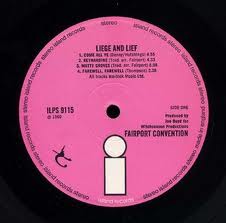
There is a report by John Dugdale in the Guardian today (gu.com/p/3daqd/tf) on the author event I took part in last Monday with Barry Forshaw, Mark Billingham, Laura Wilson and pathologist Carla Connelly at the British Library. He correctly says we discussed violence in our books at length and considered any taboos in our writing. I forgot to mention that in Dead Man’s Land there was to be a scene of gang rape. I sat at the head of that chapter for days thinking: my wife and kids are going to read this. I really didn’t want to write it. Yet it was a pivotal inciting incident. Then the solution came to me: tell it in song. Not some cheery ditty, but a murder ballad (or rape ballad I suppose). In the end I re-worked the lyrics of Fairport Convention’s Matty Groves (a sort of Lady Chatterley’s Lover tale with added murder, marvellously sung by Sandy Denny) and had one of the characters sing that. I checked with Joe Boyd, who produced the album Liege and Lief,

images-1

that I wasn’t breaching any copyright by keeping one line of the original words in as a clue to its origins, but he assured me it was a traditional piece. I was subsequently asked (of which more later) to help with a piece for the forthcoming Benjamin Britten centenary at Snape Maltings near Aldeburgh. And I discovered that Britten, too, had used a version of the Matty Groves story in a piece called The Ballad of Little Musgrave and Lady Barnard (for male voices and piano). If you look up that piece, it will say, bizarrely, that the world premier was at Oflag V11b, a POW camp in Germany. Britten composed it in 1943 or Richard Wood, the husband of one of Britten’s singers who was a POW at the camp at Eichstätt, Bavaria. He organised a music festival for the prisoners between February and March 1944 and Britten’s work – sent out in a Red Cross parcel – was performed at seven of the concerts. The Imperial War Museum has the original score. As part of the Britten centenary celebrations Jon Boden, BBC Radio 2’s ‘Folksinger of the Year’ 2010, weaves a new work into The Ballad of Little Musgrave and Lady Barnard at Snape Maltings on August 11 (see www.brittenaldeburgh.co.uk). My efforts – with someone else supplying the music – will be at the same venue on June 12.

A MODAL CITIZEN

It was broadcaster Robert Elms who first told me about Matthew Halsall’s music. ‘Mancunian Modal’ he called it and it was a fair description – on Colour Me Yes, the first album I picked up (and have hardly put down since), the young trumpeter channels the sounds and ethos of Kind of Blue and late John Coltrane and Alice Coltrane. Last year, live at Ronnie Scott’s, in the midst of a power cut, he even did Alice’s Journey in Satchidananda (featuring Rachael Gladwin’s harp and the great Coltrane-esque Nat Birchall’s sax). If there was a slight unease about the whole project, it was that although he captured the mood and spirit of those Miles and Trane  albums perfectly, was there a danger of it becoming a retro dead end? The feeling at the end of the evening was: brilliant gig, but where does Halsall go from here? The answer is, all over the place. As well a gigging as a DJ, helming Gondwana Records and remixing, he is now running not one but two working groups (the regular band, usually a sextet, that plays Ronnie Scott’s on the 24th of this month and a bold new trio with beats and electronics; not to mention the occasional 12-piece Gondwana Orchestra), as well as performing with those cutting-edge hipsters, the Brighouse & Rastrick Band.

clip_image002

Plus his new album, Fletcher Moss Park, shows a marked shift in direction, with various changes in personnel and a string section. Although recorded over a number of years, it has a genuine coherence, even when Halsall himself sits out for two numbers and lets the strings take the melodic weight.

Fletcher Moss Park, which is an actual green space on the fringes of Manchester, is elegant, reflective, tinged with melancholy at times, but like all Halsall’s albums, very life-affirming. I’ll be watching him at Ronnie’s, but down the line I also can’t wait to see his synth- and effects-laden trio with either the Cinematic Orchestra’s Luke Flowers or GoGo Penguin’s Rob Turner on drums, both hypnotic players to listen to and watch, and Taz Modi on squelchy bass lines.

www.matthewhalsall.com

www.gondwanarecords.com

www.ronniescotts.co.uk

THE WRONG MAN

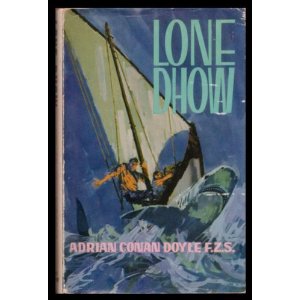
Don’t ever buy second-hand books with a New Year’s Day hangover. Wondering around a local used bookshop with my eyes narrowed against the punishing light, I came across what I thought was a true-life adventure by Sir Arthur Conan Doyle called Lone Dhow. When I got home, my eyes focussed a little better and I saw it was by ADRIAN Conan Doyle, ACD’s son by his second wife Jean. Lone Dhow is a tale about trying to capture a live tiger shark for the University of Geneva and there517DDydHxOL._SL500_AA300_ is something rather self-regarding about the tone. Certainly ACD’s biographer Andrew Lycett is less than complimentary about Adrian, calling him ‘a spendthrift playboy…who used the Conan Doyle estate as a milch-cow’. Adrian wrote a volume of Holmes stories (apparently with the help of John Dickson Carr), published as The Exploits of Sherlock Holmes, and established a replica of Holmes’s 221b at his home in Switzerland. Some of the tales are rather stilted but the best match the quality of his father’s later tales. There is an interesting interview by a young Joan Bakewell Adrian with on You Tube that includes him driving his Lamborghini and showing off his medieval castle and its Holmes’s shrine: http://www.youtube.com/watch?v=THtIleV3sfg

FAME’S GAMES

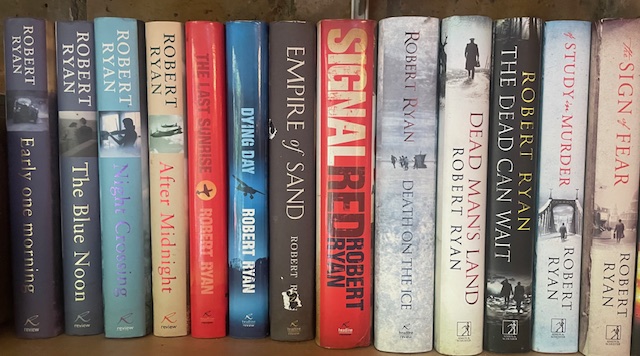
The new novel Dead Man’s Land (out today, January 3rd) is dedicated to Clive Powell, “a genuine Leigh pal”. Some of you may know that Clive Powell is the real name of one of Leigh’s most famous sons, Georgie Fame. I have met him several times over the past few years and his famed all-nighters at Soho’s Flamingo club in the early 60s were referenced in my book Signal Red, about the Great Train Robbery.

images-1

This time I wanted his help because the regiment in the new novel is a ‘Pals’ battalion, one of the units of Kitchener’s New Army that were raised to replace early losses, and consisted of men from the same village or profession. So there were Salford Pals, Liverpool Pals, Taxi Driver, Artist and Footballer Pals. There wasn’t, however, actually a Pals from the cotton town of Leigh, although I’ve invented one. Originally I used quite a lot of ‘Lanky’ dialect and local phrases for the soldier’s conversations, and Georgie was going to help out by checking their authenticity. Sadly, early readers said they found those sections impenetrable and I re-wrote them in more straightforward language, meaning I no longer needed Mr Fame’s help. Still, Georgie’s concerts have given me much pleasure of late and, coming up to 70, he shows no sign of stopping – his new record Lost in a Lover’s Dream is a laidback corker and he will be playing Ronnie Scott’s for the week starting April 8th, where he’ll no doubt telling stories about the Zagreb club owner and vibes player who inspired the new album.

Tickets: www.ronniescotts.co.uk

Album: www.juno.co.uk/labels/Three+Line+Whip/


deadmansland


THE CASE OF THE EARLY ADOPTER

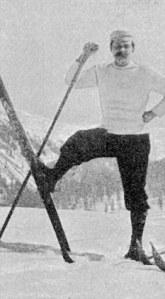
I have a piece in this weekend’s Sunday Times Travel on skiing (very badly) in Arosa in Switzerland. I was drawn to the resort partly because at the time I was writing Dead Man’s Land, featuring Dr Watson, and I knew Sir Arthur Conan Doyle had put Arosa on the map. The author was a keen sportsman and when he was staying at Davos (for his wife’s health) he ordered skis from Norway and set about teaching himself the discipline. As he wrote in The Strand magazine in 1894 “You let yourself go, gliding delightfully over the gentle slopes, flying down the steeper ones, taking an occasional cropper, but getting as near to flying as any earthbound man can. In that glorious air it is a delightful experience.’”

He was soon good enough to attempt the treacherous crossing over the Maienfelder Furka pass linking Davos to Arosa, which he did in the company of two local guides (the Branger Brothers). “But now we had a pleasure which boots can never give,” he wrote, “For a third of a mile we shot along over gently dipping curves, skimming down into the valley without a motion of our feet.  In that great untrodden waste, with snow-fields bounding our vision on every side and no marks of life save the tracks of chamois and of foxes, it was glorious to whizz along in this easy fashion.” Conan Doyle was one of the first English writers to eulogize the joys of skiing and he prophesized: “I am convinced that there will come a time when hundreds of Englishmen will come to Switzerland for the ‘skiing’ season.” Within a few years both Davos and Arosa became winter favourites of his readers.

ANMP03

FOUR PLUS ONE

In my introduction to the Complete Sherlock Holmes e-book (available for free – http://tinyurl.com/c9hp4ww), I seem to have inadvertently upped the number of novels in the Conan Doyle canon from four to five. One of the joys of e-books is that, unlike with print versions, such glitches can be easily fixed. Yet I knew very well there were four novels – A Study in Scarlet, The Sign of Four, The Hound of Baskervilles, The Valley of Fear – and I can only assume I was so taken in by reading Anthony Horowitz’s House of Silk, I added it to the tally. House of Silk, like Dead Man’s Land, has the blessing of the Conan Doyle Estate, although unlike DML it is written in the style of ACD. Most Holmes ‘continuation’ novels read like a pale imitation of the original, or are so reverential they end up wooden and stilted. Not House of Silk – Horowitz nails the classic characters and doesn’t forget to add a rip-roaring plot. Highly recommended and best read by gaslight.

THE NEXT BIG THING

The omni-talented Barry Forshaw, head honcho of Crime Time (www.crimetime.co.uk) and author of Death in a Cold Climate: A Guide to Scandinavian Crime Fiction, British Crime Film and Guns for Hire: The Modern Adventure Thriller, among many others, asked me to get involved in this round-robin called The Next Big Thing.

The idea is that I answer the following questions about my writing then recommend other authors who also answer the questions and they in turn recommend other authors until the world begs for mercy. You can find Barry’s answers on the Crime Time website, and my “tag” authors at the end of the questionnaire, who should be posting within the week.

1) What is the working title of your next book?

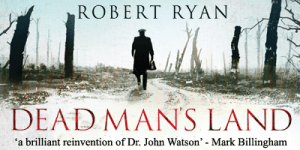
Dead Man’s Land, out on January 3.

 2) Where did the idea come from for the book?

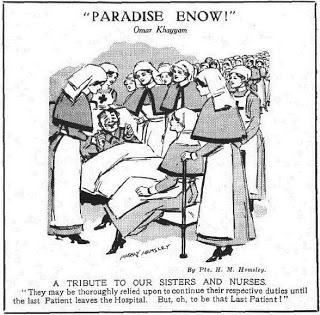
Dead Man’s Land is inspired by a line from Conan Doyle’s His Last Bow, set in 1914, in which Sherlock Holmes says that Watson intends to ‘rejoin his old service’ – by this time the Royal Army Medical Corps. So it is Dr. Watson’s adventures in WW1.

3) What genre does your book fall under?

Historical thriller.

4) What actors would you choose to play the part of your characters in a movie rendition?

The central character is Dr John Watson – Holmes’s sidekick – but without the Great Detective. It roughly follows Conan Doyle’s (sometimes wayward) chronology of his heroes, so I need an actor in his 60s, someone like Tom Wilkinson, martin Shaw or Michael Kitchen. I’m thinking Kelly Riley (too young?) or Alex Kingston as his flame-haired nurse.

5) What is the one sentence synopsis of your book?

With thousands dying every day on the Western Front, what better place to commit a murder..

6) Will your book be self-published or represented by an agency?

It is published by Simon & Schuster.

7) How long did it take you to write the first draft of the manuscript?

About seven months.

8) What other books would you compare this story to within your genre?

Despite having Dr Watson in it, not Conan Doyle, more Len Deighton or early Robert Harris.

9) Who or what inspired you to write this book?

My editor at S&S, Maxine Hitchcock said they were looking for a novel based on ‘a detective in the trenches’. She set me on the road to recalling that Dr Watson had served in WW1.

10) What else about your book might pique the reader’s interest?

Winston Churchill is a pivotal figure in the novel, because after Gallipoli he went into the army and served on the front line.

To see how other authors tackle this list, go along and visit:

Dean Crawford, a British Michael Crichton and author of science-thrillers Apocalypse, Covenant and Immortal at www.deancrawfordbooks.com.

Howard Linskey, who brings Get Carter and crew bang up to date in The Drop, The Damage and The Dead on http://howardlinskey.blogspot.co.uk/.

Frank Barnard, ace WW2 flying chronicler (Blue Man Falling, Band of Eagles, To Play The Fox) and, with A Time For Heroes, WW1 as well, at www.frankbarnard.com.deadmansland

221b or not 221b

As a tie-in to the imminent release of the Dr Watson novel DEAD MAN’S LAND, Simon & Schuster has made available a free e-book of the Complete Sherlock Holmes. As part of the package they asked me to write an introduction, which I duly did. Then the artwork came. You do realise, I told them, that it wouldn’t say 221b above the door? That the ‘b’ signified Holmes’s and Watson’s lodgings, not the whole building? There would be a doorbell or door pull marked ‘b’. We’ll get letters, I said. My editors thought for a minute and said: We’ll get letters if we don’t put it there. Apparently Stephen Moffat and Mark Gatiss had similar discussions with their BBC Sherlock re-boot. In the end they decided the address was so iconic, the ‘b’ had to stay. And if it’s good enough for them….


Sherlock Holmes Ebook version 2

http://books.simonandschuster.com/Complete-Sherlock-Holmes/Arthur-Conan-Doyle/9781471127182


http://www.amazon.co.uk/The-Complete-Sherlock-Holmes-ebook/dp/B00AHEMYEY


NAMING THE DEAD

It is a very tenuous link between jazz and the dead of World War One, but I inadvertently made the connection last week. I had gone to The Forum in Kentish Town to interview Mancunian trumpet player Matthew Halsall (of whom more another time) and I was sitting with the band in a nearby café. I mentioned Dead Man’s Land, the new Dr Watson novel, and the young drummer to my right became very animated on the subject of WW1. This was Rob Turner who, as well as filling the drum chair for Halsall that night (it is often taken by Cinematic Orchestra’s Luke Flowers), is also a ‘sound artist’. By another coincidence he also drums for the piano trio GoGo Penguin, an album I had recently boughtGONDCD008-GoGo-Penguin-Fanfares-2012-Cover and thoroughly enjoyed. To use name-dropping shorthand – if you like EST, Neil Cowley, Albaran Trio or Bad Plus, you’ll love Fanfares (on the Gondwana label) although it has strong elements, especially in the interplay of the rhythm section, that is all its own. Turner is not your average jazz drummer – as influences he cites not Tony Williams or Jack DeJohnette but Aphex Twin and John Cage (he quotes the latter: ‘There is no noise, only sound.’)

But, to the war dead. That evening Turner let drop a project so ambitious, I called him up to discuss it a few days later. ‘It came to me overnight, literally,’ he said down the phone. ‘I woke up and thought – I wonder if it can be done? So I went to Steve Mead, artistic director of the Manchester Jazz Festival and he mentioned it to the Imperial War Museum and they were really interested.’

The idea is to build a text-recognition machine that will read out the names of all the casualties of World War One, close to forty million of them. ‘We wanted it to have no political agenda, so all countries are represented, all sides and both military and civilian casualties, too. It will operate 24 hours a day, with 3 seconds or so allowed for each name. I did think about running it chronologically, so if people knew their relative died at Loos in 1915, then they could come along. But the problem was you have these clumps where people died in vast numbers, such as day one of The Somme, that it skewers the timing. So we think it will be in alphabetical order.’ The next stage is to try and get funding for further investigation into the computer software and, if it goes ahead, to build the machine in time for the 100th anniversary of the start of the war in 2014 (it would probably be installed at IWM North). And how long will it take to recite the roll call of the fallen? Turner: ‘Well, that’s one thing that brings home the scale of the losses– even running day and night, it will take four years to list them all.’

GoGo Penguin play The Vortex (020 7254 4097, http://www.vortexjazz.co.uk) in Dalston,  London on December 7th, with a DJ set by Matthew Halsall.