Author Archives: Robert Ryan

Unknown's avatar

About Robert Ryan

Author and Journalist

A Duck With A View

The first thing everyone mentions about Hutong, the Chinese restaurant in The Shard, is not the view (very good) or the service (very jolly) or the red-lantern and dark wood décor (very sleek) but the prices (very high).

HUTONG 1

They are as incredible as Renzo Piano’s you’ll-have-someone’s-eye-out-with-that skyscraper – like the building itself, they just keep on climbing, until you are hovering around £60 for a Peking duck. But everything in The Shard is expensive – when the Shangri-la Hotel opens in May, rooms will start at £350 a night. To visit the viewing platform unannounced you’ll be mugged for £29.95pp (you can knock a fiver off for pre-booking). So when my kids said they’d like to go up The Shard for their half-term treat  I knew I was going to drop at least a hundred quid for the four of us for the outing, before food and drink. (To be fair, there was a very useful kids-go-free special h/t offer for the viewing gallery, but both ours being over 16, we were looking at full price). Oddly, though, Hutong came to the rescue.

HUTONG 2
It had just launched a set lunchtime menu of dim sum, any five dishes (e.g. poached wontons with chilli-garlic sauce, ginger and spring onion lobster buns, baked Wagyu beef puffs) for £28pp. OK, so that’s really no bargain by Chinatown standards, but at The Shard it’s a steal (and certainly comparable to Yauatcha in Soho). And you do get four pieces of each one, they are freshly made every morning and they are pretty damn’ fine. Now, I hear you say, four times £28 comes to… but you don’t need one set lunch each. We did two of them (£56) and half a Peking duck (£30), which is flashily carved at your tableside, and left replete after two hours for £86 (plus drinks and 12.5% service). Still expensive, but I haven’t even factored in the view yet.

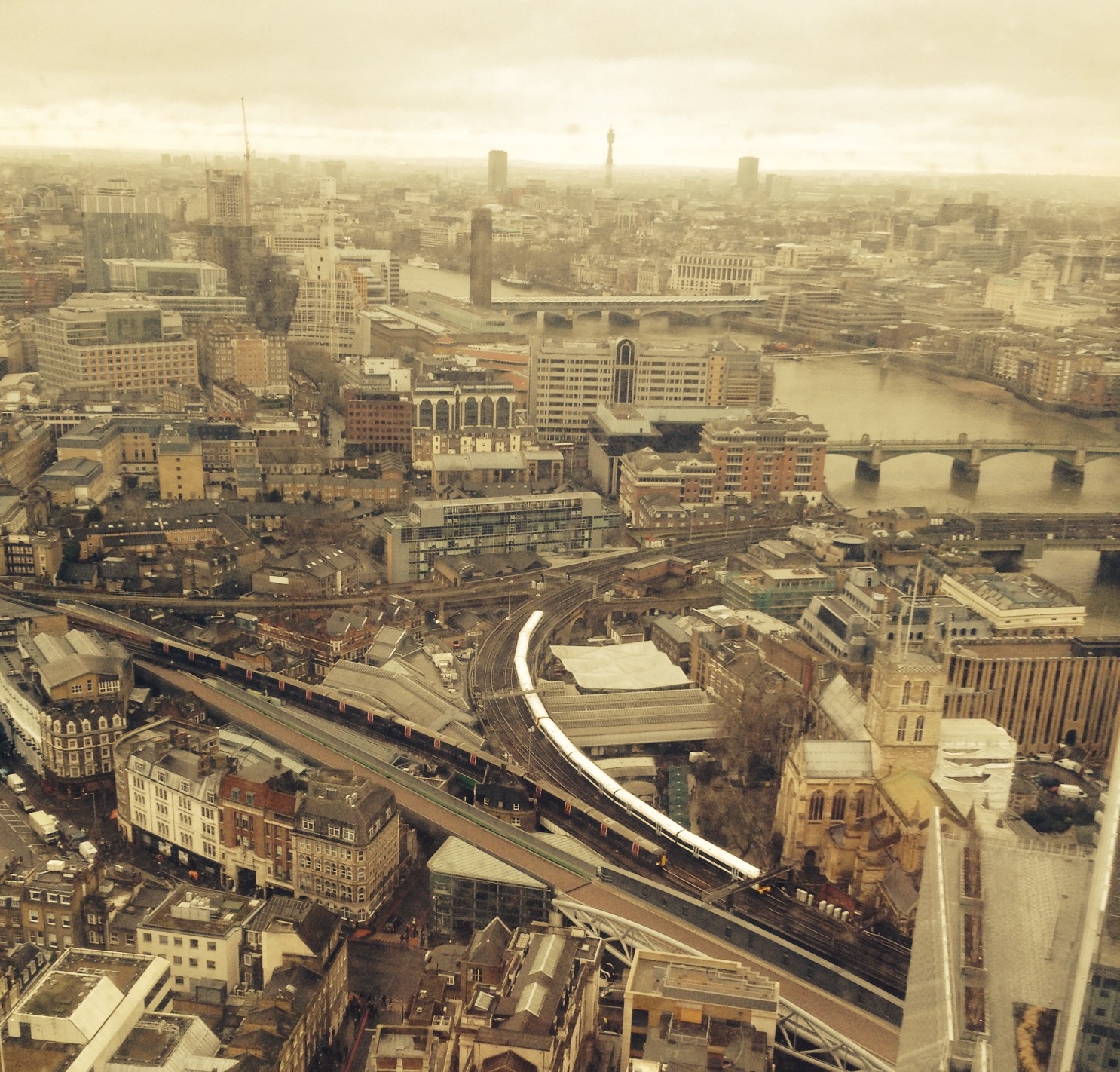
Hutong is on the 33rd floor, so only about half way up the this anorexic glass pyramid, but even so it’s worth trying to bag a window seat for the always-mesmerising London birds’-eye view (I particularly like looking down on HMS Belfast for some reason, although we were seated on a different side). And if you don’t get a window, there is always the lavatory, from where you can gaze along the river to Tower Bridge and across South London to Kent. In the men’s, the urinals are positioned in front of plate glass windows, so that you stare down on what looks like a vast Hornby construction, with trains snaking in and out of London Bridge Station, feeling like The Fat Controller. Or perhaps Bob Crow.

* Hutong, Level 33, The Shard, 31 St Thomas Street, London SE19RY (020 3011 1257, http://www.aquahutong.co.uk)

photo 5This is the view from the table, looking over Borough Market and Tate Modern.

Thanks to Gina Ryan for the pics.

The Musketeer as Sherlock

A “re-imagined” Three Musketeers starts tonight on BBC. When a couple of months ago I was researching the history of detective fiction for a talk I was giving, I came across a scene where d’Artagnan shows powers of analysis of a crime scene worthy of Holmes himself. So will this facility survive the update? This is the (rather lengthy, but worth it) passage:

“While the king was engaged in making these last-mentioned arrangements in order to ascertain the truth, D’Artagnan, without losing a second, ran to the stable, took down the lantern, saddled his horse himself, and proceeded towards the place his majesty had indicated. According to the promise he had made, he had not accosted any one; and, as we have observed, he had carried his scruples so far as to do without the assistance of the stable-helpers altogether. D’Artagnan was one of those
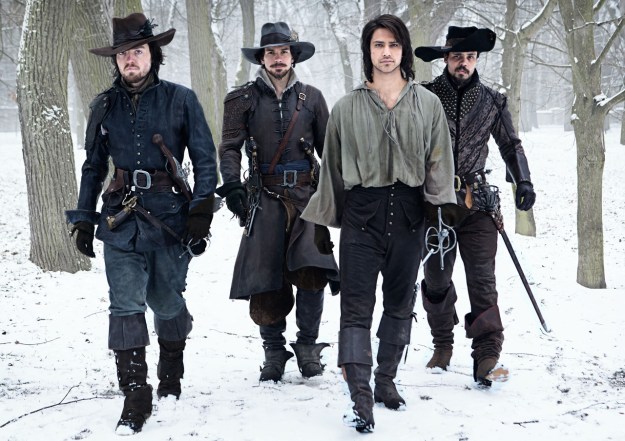
bbc-three-musketeers-2014promo

who in moments of difficulty pride themselves on increasing their own value. By dint of hard galloping, he in less than five minutes reached the wood, fastened his horse to the first tree he came to, and penetrated to the broad open space on foot. He then began to inspect most carefully, on foot and with his lantern in his hand, the whole surface of the Rond-point, went forward, turned back again, measured, examined, and after half an hour’s minute inspection, he returned silently to where he had left his horse, and pursued his way in deep reflection and at a foot-pace to Fontainebleau. Louis was waiting in his cabinet; he was alone, and with a pencil was scribbling on paper certain lines which D’Artagnan at the first glance recognized as unequal and very much touched up. The conclusion he arrived at was, that they must be verses. The king raised his head and perceived D’Artagnan. “Well, monsieur,” he said, “do you bring me any news?”
“Yes, sire.”
“What have you seen?”
“As far as probability goes, sire—” D’Artagnan began to reply.
“It was certainty I requested of you.”
“I will approach it as near as I possibly can. The weather was very well adapted for investigations of the character I have just made; it has been raining this evening, and the roads were wet and muddy—”
“Well, the result, M. d’Artagnan?”
“Sire, your majesty told me that there was a horse lying dead in the cross-road of the Bois-Rochin, and I began, therefore, by studying the roads. I say the roads, because the center of the cross-road is reached by four separate roads. The one that I myself took was the only one that presented any fresh traces. Two horses had followed it side by side; their eight feet were marked very distinctly in the clay. One of the riders was more impatient than the other, for the footprints of the one were invariably in advance of the other about half a horse’s length.”
“Are you quite sure they were traveling together?” said the king.
“Yes sire. The horses are two rather large animals of equal pace,—horses well used to maneuvers of all kinds, for they wheeled round the barrier of the Rond-point together.”
“Well—and after?”
“The two cavaliers paused there for a minute, no doubt to arrange the conditions of the engagement; the horses grew restless and impatient. One of the riders spoke, while the other listened and seemed to have contented himself by simply answering. His horse pawed the ground, which proves that his attention was so taken up by listening that he let the bridle fall from his hand.”
“A hostile meeting did take place then?”
“Undoubtedly.”
“Continue; you are a very accurate observer.”
“One of the two cavaliers remained where he was standing, the one, in fact, who had been listening; the other crossed the open space, and at first placed himself directly opposite to his adversary. The one who had remained stationary traversed the Rond-point at a gallop, about two-thirds of its length, thinking that by this means he would gain upon his opponent; but the latter had followed the circumference of the wood.”
“You are ignorant of their names, I suppose?”
“Completely so, sire. Only he who followed the circumference of the wood was mounted on a black horse.”
“How do you know that?”
“I found a few hairs of his tail among the brambles which bordered the sides of the ditch.”
“Go on.”
“As for the other horse, there can be no trouble in describing him, since he was left dead on the field of battle.”
“What was the cause of his death?”
“A ball which had passed through his brain.”
“Was the ball that of a pistol or a gun?”
“It was a pistol-bullet, sire. Besides, the manner in which the horse was wounded explained to me the tactics of the man who had killed it. He had followed the circumference of the wood in order to take his adversary in flank. Moreover, I followed his foot-tracks on the grass.”
“The tracks of the black horse, do you mean?”
“Yes, sire.”
“Go on, Monsieur d’Artagnan.”
“As your majesty now perceives the position of the two adversaries, I will, for a moment, leave the cavalier who had remained stationary for the one who started off at a gallop.”
“Do so.”
“The horse of the cavalier who rode at full speed was killed on the spot.”
“How do you know that?”
“The cavalier had not time even to throw himself off his horse, and so fell with it. I observed the impression of his leg, which, with a great effort, he was enabled to extricate from under the horse. The spur, pressed down by the weight of the animal, had plowed up the ground.”
“Very good; and what did he do as soon as he rose up again?”
“He walked straight up to his adversary.”
“Who still remained upon the verge of the forest?”
“Yes, sire. Then, having reached a favorable distance, he stopped firmly, for the impression of both his heels are left in the ground quite close to each other, fired, and missed his adversary.”
“How do you know he did not hit him?”
“I found a hat with a ball through it.”
“Ah, a proof, then!” exclaimed the king.
“Insufficient, sire,” replied D’Artagnan, coldly; “it is a hat without any letters indicating its ownership, without arms; a red feather, as all hats have; the lace, even, had nothing particular in it.”
“Did the man with the hat through which the bullet had passed fire a second time?”
“Oh, sire, he had already fired twice.”
“How did you ascertain that?”
“I found the waddings of the pistol.”
“And what became of the bullet which did not kill the horse?”
“It cut in two the feather of the hat belonging to him against whom it was directed, and broke a small birch at the other end of the open glade.”
“In that case, then, the man on the black horse was disarmed, whilst his adversary had still one more shot to fire?”
“Sire, while the dismounted rider was extricating himself from his horse, the other was reloading his pistol. Only, he was much agitated while he was loading it, and his hand trembled greatly.”
“How do you know that?”
“Half the charge fell to the ground, and he threw the ramrod aside, not having time to replace it in the pistol.”
“Monsieur d’Artagnan, this is marvellous you tell me.”
“It is only close observation, sire, and the commonest highwayman could tell as much.”
“The whole scene is before me from the manner in which you relate it.”
“I have, in fact, reconstructed it in my own mind, with merely a few alterations.”
“And now,” said the king, “let us return to the dismounted cavalier. You were saying that he walked towards his adversary while the latter was loading his pistol.”
“Yes; but at the very moment he himself was taking aim, the other fired.”
“Oh!” said the king; “and the shot?”
“The shot told terribly, sire; the dismounted cavalier fell upon his face, after having staggered forward three or four paces.”
“Where was he hit?”
“In two places; in the first place, in his right hand, and then, by the same bullet, in his chest.”
“But how could you ascertain that?” inquired the king, full of admiration.
“By a very simple means; the butt end of the pistol was covered with blood, and the trace of the bullet could be observed, with fragments of a broken ring. The wounded man, in all probability, had the ring-finger and the little finger carried off.”
“As far as the hand goes, I have nothing to say; but the chest?”
“Sire, there were two small pools of blood, at a distance of about two feet and a half from each other. At one of these pools of blood the grass was torn up by the clenched hand; at the other, the grass was simply pressed down by the weight of the body.”
“Poor De Guiche!” exclaimed the king.
“Ah! it was M. de Guiche, then?” said the musketeer, quietly. “I suspected it, but did not venture to mention it to your majesty.”
“And what made you suspect it?”
“I recognized the De Gramont arms upon the holsters of the dead horse.”
“And you think he is seriously wounded?”
“Very seriously, since he fell immediately, and remained a long time in the same place; however, he was able to walk, as he left the spot, supported by two friends.”
“You met him returning, then?”
“No; but I observed the footprints of three men; the one on the right and the one on the left walked freely and easily, but the one in the middle dragged his feet as he walked; besides, he left traces of blood at every step he took.”
“Now, monsieur, since you saw the combat so distinctly that not a single detail seems to have escaped you, tell me something about De Guiche’s adversary.”
“Oh, sire, I do not know him.”
“And yet you see everything very clearly.”
“Yes, sire, I see everything; but I do not tell all I see; and, since the poor devil has escaped, your majesty will permit me to say that I do not intend to denounce him.”
“And yet he is guilty, since he has fought a duel, monsieur.”
“Not guilty in my eyes, sire,” said D’Artagnan, coldly.
“Monsieur!” exclaimed the king, “are you aware of what you are saying?”
“Perfectly, sire; but, according to my notions, a man who fights a duel is a brave man; such, at least, is my own opinion; but your majesty may have another, it is but natural, for you are master here.”
“Monsieur d’Artagnan, I ordered you, however—”
D’Artagnan interrupted the king by a respectful gesture. “You ordered me, sire, to gather what particulars I could, respecting a hostile meeting that had taken place; those particulars you have. If you order me to arrest M. de Guiche’s adversary, I will do so; but do not order me to denounce him to you, for in that case I will not obey.”
“Very well! Arrest him, then.”
“Give me his name, sire.”
The king stamped his foot angrily; but after a moment’s reflection, he said, “You are right—ten times, twenty times, a hundred times right.”
“That is my opinion, sire: I am happy that, this time, it accords with your majesty’s.”
“One word more. Who assisted Guiche?”
“I do not know, sire.”
“But you speak of two men. There was a person present, then, as second.”
“There was no second, sire. Nay, more than that, when M. de Guiche fell, his adversary fled without giving him any assistance.”
“The miserable coward!” exclaimed the king.
“The consequence of your ordinances, sire. If a man has fought well, and fairly, and has already escaped one chance of death, he naturally wishes to escape a second. M. de Bouteville cannot be forgotten very easily.”
“And so, men turn cowards.”
“No, they become prudent.”
“And he has fled, then, you say?”
“Yes; and as fast as his horse could possibly carry him.”
“In what direction?”
“In the direction of the château.”
“Well, and after that?”
“Afterwards, as I have had the honor of telling your majesty, two men on foot arrived, who carried M. de Guiche back with them.”
“What proof have you that these men arrived after the combat?”
“A very evident proof, sire; at the moment the encounter took place, the rain had just ceased, the ground had not had time to imbibe the moisture, and was, consequently, soaked; the footsteps sank in the ground; but while M. de Guiche was lying there in a fainting condition, the ground became firm again, and the footsteps made a less sensible impression.”
Louis clapped his hands together in sign of admiration. “Monsieur d’Artagnan,” he said, “you are positively the cleverest man in my kingdom.”
“The identical thing M. de Richelieu thought, and M. de Mazarin said, sire.”
“And now, it remains for us to see if your sagacity is at fault.”
“Oh! sire, a man may be mistaken; humanum est errare,” said the musketeer, philosophically.
“In that case, you are not human, Monsieur d’Artagnan, for I believe you are never mistaken.”
“Your majesty said that we were going to see whether such was the case, or not.”
“Yes.”
“In what way, may I venture to ask?”
“I have sent for M. de Manicamp, and M. de Manicamp is coming.”
“And M. de Manicamp knows the secret?”
“De Guiche has no secrets from M. de Manicamp.”
D’Artagnan shook his head. “No one was present at the combat, I repeat; and unless M. de Manicamp was one of the two men who brought him back—”
“Hush!” said the king, “he is coming; remain, and listen attentively.”
“Very good, sire.”
 

Review of Dead Can Wait in The Times

This from Marcel Berlins’ crime round-up:

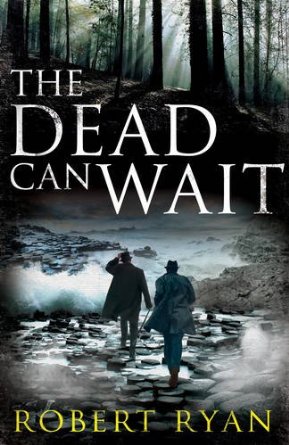
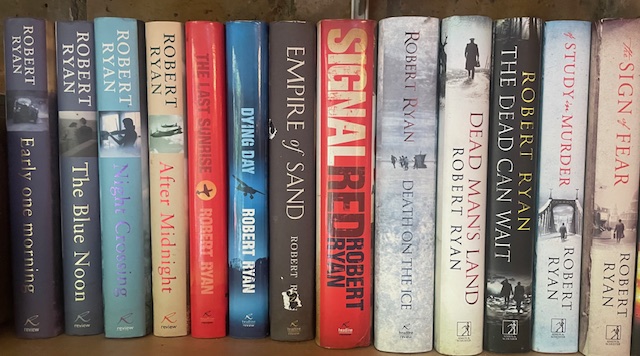
The Dead Can Wait by Robert Ryan
Dr John Watson was not, it seems, quite as dim as he’s portrayed in the Sherlock Holmes stories. Robert Ryan (with the consent of the Conan Doyle estate) reveals his true mettle. The Dead Can Wait is in no sense a pastiche, but a seriously good, very readable, well-researched novel incorporating the First World War, detection and espionage. It is 1916. Watson has become an expert on the injuries and mental traumas suffered by soldiers in battle. The British are secretly developing a new kind of weapon. But, in its first test, seven men involved become insane, then die spectacularly. The sole survivor is rendered mute. Watson is commanded to discover the causes of the tragedy, but there are foreign spies around and enemies within.
The Dead Can Wait by Robert Ryan, Simon and Schuster, 463 pp, £18.99. To buy this book for £14.99, visit thetimes.co.uk/bookshop or call 0845 2712134

The novel is partly set on ‘the most lethal road in England’, of which more later:

images

THE DEAD CAN WAIT: FIRST REVIEW

This review is from Manda Scott, of the Historical Writers’ Association (www.TheHWA.co.uk) a.k.a M.C.Scott (Rome: The Art of War):

“I became a fan of Rob Ryan’s work at Harrogate History Fest in October, when I heard him speak on a panel about Sherlock Holmes….. Apparently there was a single line in one of the last Holmes books which said that Watson had gone back to his ‘old unit’ – that being the RAMC, and given that we were on the brink of WWI, that means he went back to war.

51U2bJ9rlJL._SY445_

Thus arises one of the best post-Conan Doyle Sherlockian series, and a fantastic historical crime series. The Major John Watson we come to know in the trenches in DEAD MAN’S LAND and again here in the UK in The Dead Can Wait is a humane, compassionate, competent individual, who nevertheless appreciates the help of his steadily deteriorating friend, Holmes. The horrors of war are not stinted, but nor are they gratuitous. In DML, we (well, I) learned a huge amount about nurses and the various auxilliaries and how they worked, while in TDCW, we (I) learn a lot we (I) didn’t know about ‘shell shock’ and then, later, about the early development of tanks. It’s fascinating, and yet none of it is presented as ‘here is the research I did, now suck it up and learn it’ which is so often the case in historical novels of this sort. It’s all integral to the plot, and carries the dynamic tension even as we’re given a virtual tour of the tank testing grounds. There’s a truly scary German woman-spy, part of a network called the She Wolves, of whom I’m sure (I hope) we’ll learn more, and the very welcome return of Mrs Gregson, the red-headed, motor-bike riding, thoroughly competent nursing auxilliary.

In a year when there are going to be 1,000 ( at least) books about WWI published, this will be one of the first, and I am prepared to bet, one of the best. It’s a cracking, fulfilling, utterly satisfying read and you should get a copy now…”

Out January 2 in hardback and ebook.

MIAMI UNCUT

This is the full version of the Miami Beach hotels article which appeared yesterday (22.12.13). The hotels here have all opened in the last year or so. Miami Beach is never cheap, especially over the next few months, but if you are flexible on dates you can usually find a decent rate at any of these – and Aloft, B2 and Freehand are good value year round and the latter is worth a pop for a drink even if you aren’t staying there (see video below).

ALOFT BRICKELL
1001 SW 2nd Ave (001-305 854 6300, starwoodhotels.com)
LOCATION? Newly opened in Brickell, a business/residential district to the south of Downtown, with good public transport links, including rail from the airport.
WHAT’S THE STORY? The rapidly expanding Aloft chain bills itself as a division of W Hotels, but the relationship to its design-conscious big brother is homeopathic – a hefty dilution is involved in terms of scale, ambition and quality of fittings. Instead, think of Aloft as a bright, good-value, much hipper version of Premier Inn that does indeed offer some ‘style at a steal’ – rooms are a fraction of W prices.
WHY STAY? Generous sized bedrooms (160, including family-friendly twin kings), 42-inch plasmas, free wi-fi, decent sized pool (albeit it in the shadow of the garage’s spiral ramps), competitive prices compared to other Brickell hotels (Mandarin Oriental, Four Seasons).
SHOULD I EAT IN? There’s a funky little lobby bar but no restaurant – the Re-Fuel snack bar offers DIY breakfast (£4.20) and munchies but luckily there is a very lively local food/bar scene a block or so away at Mary Brickell Village and along South Miami Avenue. Try the new, interesting and eccentric farm-to-table Box Park (111 SW 1st Avenue 001 305 356 8385, boxparkMiami.com, mains £12-18).
BEST FOR: Fly-drive families and couples who don’t want SoBe prices.
IT’S A PITY THAT: It’s a schlep to the beach – a fifteen-minute drive.
BOTTOM LINE: from £79, room-only. Overnight valet parking £22.50 per night.

B2
146 Biscayne Boulevard (001-305 358 4555, b2miamidowntown.com).
LOCATION? Downtown on high-rise-filled Biscayne Blvd, right by Bayside shopping mall and the port.
WHAT’S THE STORY? Six months old, the first of a projected ‘value’ chain, b2 has refurbed an old property, going for no-frills functionality in 243 clean, bright rooms with very comfortable beds. There’s free wi-fi and loan of iPads and parking is £16, but you might not need a car (see below).
WHY STAY? Brilliant location if you need to catch a boat, good prices and they have a great deal with local car2go (car2go.com) car sharing scheme – registration fee waived, 38 cents a mile, free parking, fuel and insurance.
SHOULD I EAT IN? The lobby-side Biscayne Tavern calls itself a gastropub, but its more a comfort station – stick to burgers (£9.50) and ribs (£9) etc. and you won’t go far wrong, but haute cuisine it isn’t. There’s an unusually excellent selection of craft beers.
BEST FOR: pre- and post- cruise stays.
IT’S A PITY THAT: there’s no pool.
BOTTOM LINE: Doubles from £107, room-only, £119 with breakfast. B Cruisin’ packages throw in early check-in and taxi to your ship (no b/fast), from £117 per room.

SENSE BEACH HOUSE
400 Ocean Drive (001-305 538 5529, sensebeachhouse.com).
LOCATION? At the southern of Ocean Drive, away from the ‘Strip’; not right on the water, but that’s just across the street.
WHAT’S THE STORY? Another reboot of an older property, this intimate 18-room hotel, with a rooftop pool, channels New England and the Hamptons in a Ralph Lauren style. The resort fee of £9.50 per room includes everything you need for the beach (chairs/umbrellas/towels) and wi-fi. The majority of rooms have balconies and sea glimpses.
WHY SHOULD I STAY? The low-key at-the-beach atmosphere is a nice antidote to the normal SoBe posturing.
SHOULD I EAT IN? Yes. The Local House is a dine-in or –out-on-the-terrace option, which offers good vale fresh ingredients – goats cheese croquettes (£6), mac & cheese (£7), large seafood risotto (£15).
BEST FOR: Couples wanting a more relaxed Miami Beach experience.
IT’S A PITY THAT: With just 18 rooms, it fills up so quickly at peak times
THE BOTTOM LINE: Specials sometimes come in at £120 per room, including breakfast, although £180 is more the norm; valet parking is £22.

JAMES ROYAL PALM
1545 Collins Avenue (001-305 604 5700, jameshotels.com/Miami)
LOCATION? Right on the sand, in the middle of the South Beach action.
WHAT’S THE STORY? £27m has been spent on the former Royal Palm to create a large (393 rooms) resort that harks back to the Miami glamour of the ’60s, with touches of MiMo (Miami Modern) in public areas and clean Scandinavian influences in the spacious rooms.
WHY STAY? It’s a one-stop resort, with free bikes, surfboards, paddle boards, skateboards, wi-fi, multiple bars and food outlets, lots for kids, two pools, fancy spa, huge gym, good service. Only the high prices might deter.
SHOULD I EAT IN? The Florida Cookery restaurant has fancy fusion cuisine – the oyster, oxtail
and alligator empanadas (one of each, not mixed together, £8.50) were certainly different and my South American-influenced spicy Mahi-Mahi (£18.50) had a welcome kick.
BEST FOR: well-heeled families and active couples.
IT’S A PITY THAT: It’s such a big resort – those pool areas can get crowded at peak times.
BOTTOM LINE: From £220 per night, room only. It levies a £21 resort fee per room for two loungers, umbrella, towels and fruit. Valet parking is £26 a night (although unlike some hotels they do tell guests they you can get public parking for £10 across the road). Featured by British Airways (see below).

THE GALE
1690 Collins Ave (001-305 673 0199, galehotel.com).
LOCATION? Next to The Lincoln Mall shopping/dining/nightlife area.
WHAT’S THE STORY? This elegant, family-owned 87-roomer is a chimeric fusion of two historic hotels, The Gale and The Regent, with a rooftop pool and a basement nightclub added in the link. Rooms are compact but not claustrophobic, the best with terraces, all done in classic deco B&W, but very high tech with 55-inch plasmas with a pay per view you can download onto iPod/laptop.
WHY STAY? An atmosphere that feels a step up in sophistication from its generic art deco neighbours, at a reasonable price, on hippest corner in SoBe (opposite the SLS and Delano)
SHOULD I EAT IN? There is a good Italian on site for fresh pasta and wood-fired pizza (both from £11.50), but the star of the show is the dark, clubby Regent Cocktail Bar where the barman make daiquiris just like Papa Hemingway drank (£9).
BEST FOR: 24-hour party people (there’s that nightclub on site, open to 5am on weekends)
IT’S A PITY THAT: it doesn’t have direct beach access – you get squatting rights in front of the Setai up the street.
BOTTOM LINE: from £120 room-only, plus £16 per room resort fee- includes wi-fi, beach chairs, shuttle to and from beach or restaurants, and a £10 food credit. Valet Parking is £26 a night.

SLS
1701 Collins Ave (001-305 674 1701, slshotels.com).
LOCATION? Grand – on the beach, right opposite the Delano on Collins Avenue.
WHAT’S THE STORY? A typically striking (and somewhat muddled) design job by Philippe Starck, with a little help from Lenny Kravitz, has rapidly turned the old Ritz Plaza into the local party scene du jour. There’s two pool areas, one for guests (it’s the one with a giant fibre glass duck), the other open to the public – for a minimum spend – at the cool Hyde Beach bar/club/gardens. Rooms, of which there are 140, are not huge by any means, unless you get a ‘villa’, and are mostly white with some Louis XIV styled screen prints to suggest a touch of decadence.
WHY STAY? It’s currently the epitome of South Beach bling, if that’s your thing. But the bar/pool scene is worth a bit of rubbernecking, even if you’re not staying.
SHOULD I EAT IN? Food is a big deal here – it’s open kitchen season. There’s gussied-up tapas at Bazaar by Jose Andres in two adjacent dining rooms, although I prefer the terrace of the Bar Centro, which serves a selection from his menu (platter of Spanish meats, £15; patatas bravas, £6.50), with drinks such as liquid nitrogen caiprinhas (£3.25). There is also a branch of Japanese sushi chain Katsuya. The bargain in the latter is the ‘Social Hour’, 6-9pm daily, at the hidden Dragon Lounge upstairs, when all appetisers are half price (tuna on crispy rice, £4.50) and the cocktails a very reasonable £5.
BEST FOR? Celeb spotters (Beckhams, J-Lo, assorted Kardashians), pool poseurs, people watchers.
IT’S A PITY THAT: The extras add up. There’s a £13 per room per day resort fee, but you have to pay extra for umbrellas (£6) and there is a minimum spend on drinks/food for the front row of pool chairs at the public pool (from £47.50pp, more on pool party days) even for hotel guests, which is very cheeky. Valet parking is £29.
BOTTOM LINE: Room-only from £160. Featured by Virgin Holidays + Hip Hotels (0844-573 2451, viphotels.co.uk)

FREEHAND MIAMI
2727 Indian Creek Drive (001-305 531 2727, thefreehand.com).
LOCATION? Way up at the top end of SoBe – much further and you’d be in NoBe.
WHAT’S THE STORY? Hard to believe that this shabby-boho enclave (once the Island Creek Hotel) is part-owned by Ace Hotels, but some of that brand’s magic has certainly rubbed off- this place is hugely popular, especially the bar and tropical gardens with pool.
WHY SHOULD I STAY? For the laidback, freewheeling atmosphere, the lots of activities organised/suggested and The Broken Shaker, a great and currently very hip hangout, with cutting edge cocktails from £9.
SHOULD I EAT IN? There are only wraps (£5-6) at the moment, but restaurant coming next year. Nearby Indomania (131 26th St, 001-305 535 6332, indomaniarestaurant.com) is good bet: blow-out Dutch-Indonesian rijsttafels from £15.50pp.
BEST FOR: Hipsters of all ages – but be aware that it’s a hostel, not a hotel.
IT’S A PITY THAT: It’s so far north of the main drag, but bike hire (£9.50 day) is reasonable. Street car parking only, but they have vouchers (£6.50 day)
THE BOTTOM LINE: A shared quad (with solid, Amish-built bunks) from £16pp; basic doubles £64 per room, both with breakfast included.

* I travelled to Miami as a guest of British Airways (0844 493 0758, ba.com), which features both The James (three nights from £819pp, room-only, with flights) and SLS (three nights, £789pp) and Starwood Hotels (starwoodhotels.com).

Robbery with a side order of pheasant

The route from Bridego Bridge to Leatherslade Farm in Bucks is the featured Great Drive in this Sunday’s (15.12) Drive section of the Sunday Times. To celebrate, we have a fresh version of the film, now with a racy B&W section:

The pub mentioned in the article, The Hundred of Ashendon (01296-651296, http://www.thehundredofashendon.com), is well worth a detour even if you aren’t chasing the shades of robbers past – the chef, Matt, produces robust, seasonal, well-flavoured food (I had the pheasant and bacon pie, my co-pilot a lovely piece of turbot) without being over-fancy. If I tell you he has spent time in Fergus Henderson’s kitchen, you’ll get the idea.

In The Tyre Tracks Of The Train Robbers

I recently did a Great Drive through rural Buckinghamshire for The Sunday Times Drive section. It was to follow the route taken by the Great Train Robbers as they took their haul of £2.6m from Bridego Bridge (off the B488) to their ill-fated choice of hideout, Leatherslade Farm near Brill. As Bruce Reynolds, chief planner, said in his memoir, Autobiography of a Thief: ‘The next morning Paddy and I set off in his 3.8 [Jaguar], driving up and around the target area. The more I saw, the more I liked it. I plotted a route which took us south in a dogleg onto the Thame Road. It was a great route, B-roads all the way, crossing two main roads in all.’ He isn’t kidding about the dogleg – in fact, there’s more doglegs in the 28 miles than Battersea Dog’s Home in January. You can read the results of following Reynolds and the robbers in The Sunday Times soon. Meanwhile, here is a short film we shot at the bridge (go full screen to see the captions properly – sadly it also makes my face bigger):

Thanks to Tony O’Keeffe of Jaguar Cars and Jagmeister Michael Byng, who brought along one of his Mk 2s. This is a rough version of the final film – although I am still hoping the moment when I tried to start the 3.8 with the cigarette lighter button doesn’t make the final cut.

Incidentally, as well as the usual outlets, you can now get the novel that started all this malarkey, Signal Red, through iTunes: http://tinyurl.com/pwmo8zj.

First Great Train Robbery Trailer Released

The BBC has released the first trailer (below) for the two-part Great Train Robbery film, ‘inspired by’ (as the credit have it) my novel Signal Red (as in ‘kickstarted’, which was its actual role; the finished product isn’t a film of the book). The first of the pair, A Robber’s Tale concentrates on Bruce Reynolds (Luke Evans); the second, A Copper’s Tale, centres on the dour but dedicated policeman Tommy Butler (Jim Broadbent). The screenplays are by Chris Chibnall (Dr Who, Camelot, Law & Order, United, Broadchurch), but with different directors, DOPs and editors, each has a strikingly different feel, although they both have at their core a powerful central performance from the lead actor. They are scheduled to be shown ‘soon’ – most likely before Christmas. STOP PRESS: Films now due to be shown on December 18th and 19th.