Category Archives: Music

CASSAVETES: THE JAZZ DETECTIVE

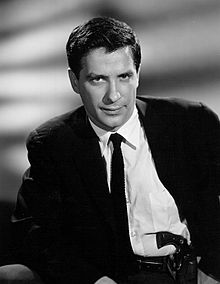
When Guy Barker and I were sketching out the idea for a piece called dZf – The Magic Flute relocated to Greenwich Village – one of our touchstones was a TV series called Johnny Staccato, which aired in the US from 1959-60. Starring John Cassavetes as a “jazz detective”, it was set in a Village jazz club called Waldo’s, and the title character was a pianist who moonlighted as a gumshoe. Or vice-versa.Unknown

The club setting (and the music played there) was crucial to us, but the only episode we managed to track down was one where the nightclub was temporarily shut down. Disappointing, to say the least. Now, though, if you have a multi-region DVD player you can enjoy all 27 episodes in the US re-issue below. And what a treat it is, from the opening credits on.

Unknown-1

The theme music is by Elmer Bernstein (‘The Magnificent Seven’), a punchy, braying wail of brass, a supercharged version of his work on The Sweet Smell of Success. The musicians playing at Waldo’s included Barney Kessel, Shelly Manne, Red Mitchell, Red Norvo, and pianist Johnny Williams (later John Williams, responsible for Star Wars, Jaws etc). Although set in the Village, nearly all the players were from the West Coast school of jazz, because, apart from a few exteriors, the series was actually filmed in LA.

220px-John_Cassavetes_Johnny_Staccato_1959

So how does it stand up? Well the scripts aren’t its strong point, but Cassavetes with his razor-sharp suits and matching cheek bones is excellent and there is something to savour in most episodes, not least Elizabeth Montgomery – Samantha in Bewitched – playing against type as a sexy femme fatale in Tempted. And the music is always great – Bernstein used three different ensembles- a big band of 25, a Birth of the Cool-sized 12-piece and an ensemble of six players  with vibes and trumpet to the fore. Listen out for a riff that sounds as if it could be a sketch for Lalo Schifrin’s later Mission Impossible theme.

51+NhpOZVPL._AA160_

If you want to skip the visuals, the soundtrack is available on an 8-CD compilation called Jazz on Film: Crime Jazz, which also includes Lee Marvin’s M Squad, the Untouchables and, best of all, two CDs of Henry Mancini’s music from Peter Gunn.

Unknown-3

24 HOURS IN SOHO @BBCCO

 On Tuesday 18th November the BBC Concert Orchestra will be performing at the Queen Elizabeth Hall with Trish Clowes, Norma Winstone and Guy Barker as part of the EFG London Jazz Festival. It is also being broadcast live on BBC3. My contribution was to produce a narrative for Guy’s new composition. An outline of that will appear in the concert programme, but this a more comprehensive version of what went into the creation of his Soho Symphony.
tbg2

Earlier this year, I received a phone call from Guy Barker, saying he had a hankering to write a new orchestral piece for the BBC Concert Orchestra (he is Associate Composer there). However, he was staring at a blank page and needed a framework. We have done this before, with dZf, a re-working of the Magic Flute, and last year That Obscure Hurt, a Henry James/Britten-inspired piece. I give Guy a narrative; he builds his music around it. This time all he had was ‘Soho’ as a theme.

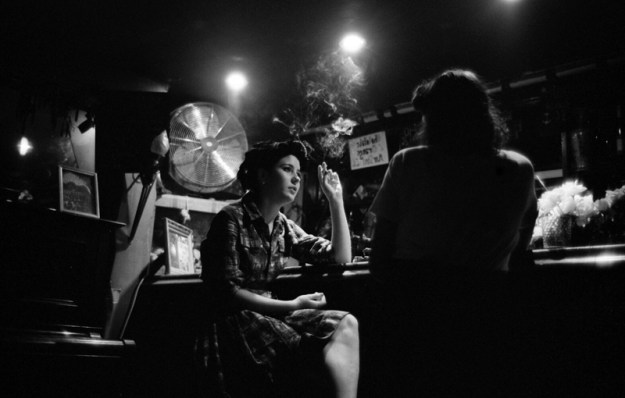
Guy wanted to mention and somehow reference in the piece some of his formative and favourite places and people and we came up with a very long list, most of which involved alcohol (often at the much-lamented Black Gardenia, above) or music or frequently both. And so I wrote a short story that is (very, very loosely) inspired by James Joyce’s Ulysses, about a boy failing to meet a girl and spending 24 hours wandering around the streets of Soho, among its ghosts, its music and its memories. Of course, once subjected to the alchemy of Guy Barker, where base stories become musically precious, things changed. So here is a guide to the thematic waymarkers in the piece, which consists of seven (part six is divided into two) sections.

  1. BACON & BOHEMIA

I opened the story with our hero living in Fitrovia and being disturbed by the smell of breakfast:

  “I am always woken early by the smell of bacon, climbing the stairs from the kitchen below, wafting under the door like a fog of temptation, tickling my nose. So I always awake with a craving for a bacon butty. But I don’t mind the premature start today. I have a date with a beautiful woman. 8am. Bar Italia.”

But it is well before the appointed hour and in this section Guy conjures up a stroll through the streets of Soho before sunrise. Bottles roll in the gutters, the garbage trucks patrol the alleys, many of the area’s characters are just waking up, others going to bed – some tired and happy, others reflecting on a night gone awry. The boy wanders down Wardour St, killing time, looking at film posters in the production houses, listening to the ‘dawn chorus’ chatter of stall-holders in Berwick St, until it is time for coffee on Frith St.

Unknown-2

  1. MOZART & MOCHA

The music here takes on a frantic quality. On the way to Bar Italia for his rendezvous he confronts the tide of workers rushing into the area, marching to their desks and workstations and shop floors, a mass of humanity on the move, blocking and knocking him, until he turns the corner sees Bar Italia (and the music takes on a touch of Fellini-esque romance).

A dominant 7th chord announces his sanctuary in this slice of La Dolce Vita, with cheeky Italian barmen serving him ‘the best espresso in town’. And serving it again. And again. No girl yet. More coffee? Why not?

Nerves jangling from too much caffeine, he leaves the bar and looks up, noticing the blue plaque declaring that a young Mozart once lived on Frith St. Here, the orchestra gradually falls away to leave a string quartet, which plays 12 bars derived a short Mozart piano piece composed by Mozart when was four.

His limbs jerky from his espresso-overload, the boy struts up Frith, past Ronnie Scott’s, Garlic & Shots, the Dog & Duck, until he comes to Soho Square, and thinks of Fifis.

  1. FAITH & FIFIS

A ‘Fifi’ was the slang name for the working girls, often of French or Belgian extraction (or pretending to be), who inhabited Soho in the pre- and post-war years.

“I light a cigarette and lean against the railings outside Église Protestante Française de Londres, the last Huguenot church in London. Would the Fifis have worshipped here? Probably not, most of those girls who came over in the ‘30s, 40s and ‘50s would have been Catholic, I guess. I look across to St Patrick’s, where maybe the Fifis confessed their sins and along to the House of St Barnabas, once a charitable organization for émigrés run by nuns, then, post-WW2, a women’s hostel, where I am sure the odd Fifi would have fetched up.”

 images-1

These thoughts on religion are suggested by a brass chorale. But it moves on to something darker, for Soho in the thirties had its own version of Jack the Ripper or the Boston Strangler – a serial killer was at work, with victims in Archer, Lexington, Rupert, Old Compton and Wardour streets, all strangled with their own silk stockings. “Jack the Strangler” was never caught.

Musing on this, he sees the ghosts of the dead Fifis, grey, pale-faced corpses. As the instruction to the orchestra on the score has it: ‘Soho Square has become an open air charnel house’.

  1. RHYTHM, BLUES & BEYOND

What Guy calls a ‘psychedelic’ start signals a section where the boy is moving from Soho Square, considering drowning his sorrows at being stood up, and thinking of all the drinking and music clubs in Soho. But on his travels he comes across Jeffery Bernard, furious at just being barred from the Colony Room, who marches him to the Coach & Horses, where Norman, the rudest landlord in London, plies them with gin and insults. Further enraged by the drink, Jeff marches off (which you’ll hear clearly in the music) and ‘borrows’ a window cleaner’s ladder. He takes it to outside 41 Dean St and leans it against the first floor window. He scuttles up it. Bangs on the glass. When the window is open he addresses those (the Bacons and the Farsons) gathered within: ‘You are all a bunch of…’

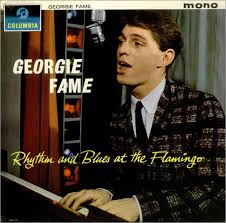
And off Jeff goes, sliding down the ladder and marching off again, the young man in tow. Here, a bluesy 12/8 section suggests the other type of club in Soho, the music ones, especially the Flamingo, and Georgie Fame’s R&B all-nighters.
Unknown-1

They pass by Kettner’s, where two men dressed in black are at work – Kenny Clayton is playing stride piano, Bill Mitchell singing. From there Jeff doubles back, heading for Jerry’s, the other famous Soho haunt of the alcoholically adventurous, and when he reaches it, there is a slowing of the music, signalling his now weary descent down the stairs into the warm, crepuscular embrace of the drinking den.

  1. GIG & GIRLS

Later, much later, there is a head that needs clearing, and our boy walks towards Archer St, which he finds populated by musical ghosts. As it is explained in the story:

“From the twenties through to the sixties, jazz musicians would crowd this street. Wall to wall it was. The snooty London Orchestral Association had it headquarters there. And they wouldn’t allow dance band musicians in. Too populist, you see. But outside, in this street here, it was like a musicians’ Labour Exchange. You wanted a gig or to get paid or to hear the gossip, you came down here.”


Archer Street

Archer Street

So you will hear this in a section reminiscent of the bright, optimistic hustle and bustle of a Pathé News reel, as the musicians crowd the streets, shooting the breeze and a line, until.. hold the phone, what’s this? Romance – or at least sex – has raised its pretty head in the score.

Archer St, you see, intersects with Windmill St, and musicians always used for the doorways that allowed them to see the famous Windmill Girls come and go. There were other women there, too. As Ronnie Scott put it years later: “These days you’d call them groupies. Back then we just thought of them as jolly good sports.”

Fired up by such thoughts, the lad, still the worse for wear, hightails it back to Dean St and Sunset Strip, one of the few remaining original strip club for which the area was once notorious. What you might call “Music To Disrobe By” is a feature in this section, with appropriate – or perhaps inappropriate – contributions from the orchestra.


images

  1. A GIRL, A GARDENIA & A GAGGIA

 a. A PEARL ON DEAN

Sobriety brings self-loathing. He doesn’t want to see girls, naked or otherwise he wants to see A particular girl.

Leaving the club, he sprints up Dean St, towards the Black Gardenia where he first met her, and BOOM! There she is, standing outside in all her tattooed glory. They speak, sweetly.

l_3d40ceb698e929cd79c2323ea9824a38

And he discovers he has been an idiot. When she said she’d meet him ‘a week today’ for an early coffee, it was well after midnight – but he was thinking of the previous day, when he had started the evening. He had turned up at the Bar Italia 24 hours too early.

After a drink at the Gardenia, they go back to Frith St, where those cheeky barmen are still serving the best espresso in town.

b) ESPRESSO SUNRISE

And so, exactly 24 hours after he left his flat in Fitzrovia, they walk out of the Bar Italia together, into the promise of a Soho dawn. The day has come full circle, and so has the piece.



MY LUNCH WITH JEFF – THE MUSICAL

On November 18 a piece of music will be premiered at the Queen Elizabeth Hall that owes its existence to a lunch I once had with Jeffrey Bernard (below).

jeffrey-bernard-2

A few months ago, I received two phone calls, a day apart, both concerning Soho. One was from the Groucho Club, asking if I had any anecdotes to contribute to a compendium it was compiling for its 30th anniversary. The other was from Guy Barker, saying he had a hankering to write a piece based on Soho for the BBC Concert Orchestra (he is Associate Composer there). However, he was staring at a blank page (well, actually a screen of the Sibelius programme) and needed a framework. Did I have any ideas for a skeleton he could flesh out with his music? We have done this before, with dZf, a re-working of the Magic Flute, and last year That Obscure Hurt, a Henry James/Britten-inspired piece. I give Guy a narrative; he builds his music around it.

Both phone calls, it seemed to me, could involve a story told to me by Jeff when, back in 1987, I interviewed him over a rather disastrous lunch at the back of the Groucho Club brasserie, when he fell asleep in the soup – the only time I have ever had to save a man from death by pea and ham. Anyway, he described an incident involving himself, the Colony Room, Francis Bacon & Co, a window cleaner’s ladder and more profanity than can be repeated here.

I wrote up the story for the Groucho and then met with Guy and said I would like to make that story at least part of the ‘Soho Symphony’ as we began to call it. I talked over other locations and tall tales we could include. I ended up with the task of combining Bar Italia, Mozart, Ronnie Scott’s, Archer St, a serial killer, the French, the Protestant church on Soho Square, Pizza Express, 20th Century Fox, ‘Fifis’ (the French and Belgian working girls of the 1950s), all-nighters at the Flamingo Club, late night drinking at Gerry’s, Harrison Marks, Paul Raymond, The Black Gardenia and, of course, that Groucho lunch, among many others.

And so, I wrote a short story that is (very, very loosely) inspired by James Joyce’s Ulysses (but, you know, more readable), about a boy failing to meet a girl and spending 24 hours wandering around the streets of Soho, among its ghosts, its music and its memories, and meeting Jeff with his ladder. To paraphrase the producer/writer Kip Hanrahan, I gave this piece of pressed tin to Guy Barker who proceeded to turn it into rolled gold.

It will be played at an ‘orchestral jazz’ concert – although Guy’s piece does not feature his usual jazz band, it is for the BBC C.O. only – featuring the symphony, plus the excellent saxophonist and composer Trish Clowes, and the vocal legend that is Norma Winstone, at the QEH on November 18, as part of the London Jazz Festival (see http://tinyurl.com/mff9g6n).

BELGIAN INTERLUDE

Berlin InterRail will be along shortly; meanwhile, here is some music….

There was a moment during Melanie de Biasio’s performance at the Purcell Room on the Southbank the other night when, as a fan of light framed her uplifted face, I felt as if I was watching Ingrid Bergman playing Joan of Arc re-incarnated with the voice of Abbey Lincoln fronting a Belgian version of The Necks.

29_melanie_de_biaso_0

Certainly anyone who popped along because of the tag ‘the Belgian Billie Holiday’ that she is often saddled with was in for a surprise. This was strange fruit all right, a cross pollination of jazz, blues, trip-hop, post-rock and late Talk Talk and it certainly wasn’t a singer showing off her chops with a succession of torch songs or standards. If anything, she used the power of her spine-tingly voice too sparingly, often simply breathing out phrases or single words to wrap around the repetitive, sometimes languorous patterns created by a band consisting of piano, keyboards (clavinet, synths) and drums. But that meant when she did let rip, it counted, and hairs stood up on necks.
In a short, intense, one-hour set she played most of new (also short) album No Deal (Play it Again Sam records) with parts of A Stomach Is Burning, her less minimal debut from a couple of years ago. It was effectively one single, stripped-down sixty-minute song, building to the wonderful I’m Gonna Leave You. The two keyboards players added mostly texture and a skeletal framework for the tunes – no long noodly jazz solos here – while drummer Dre Pallemaerts ably supplied the rhythmic heft (and the singer added smoky stabs of flute). It was an unsettling – on a good way – monochrome show, a little like the drawings that come with the album, and was brilliantly lit, creating a close, clubby atmosphere in the sometimes sterile Purcell Room.
It’s all too rare to come away from a gig thinking: well, I haven’t seen anything like that recently, but Melanie De Biasio (who is highly rated by Jamie Cullum and Gilles Peterson) will leave you scratching your head and producing weird combos of artists to explain her to those who don’t yet know her sound. Although possibly none as odd as Joan of Arc.
http://www.melaniedebiasio.

Kyle Eastwood: New York, Paris and Ken Clarke

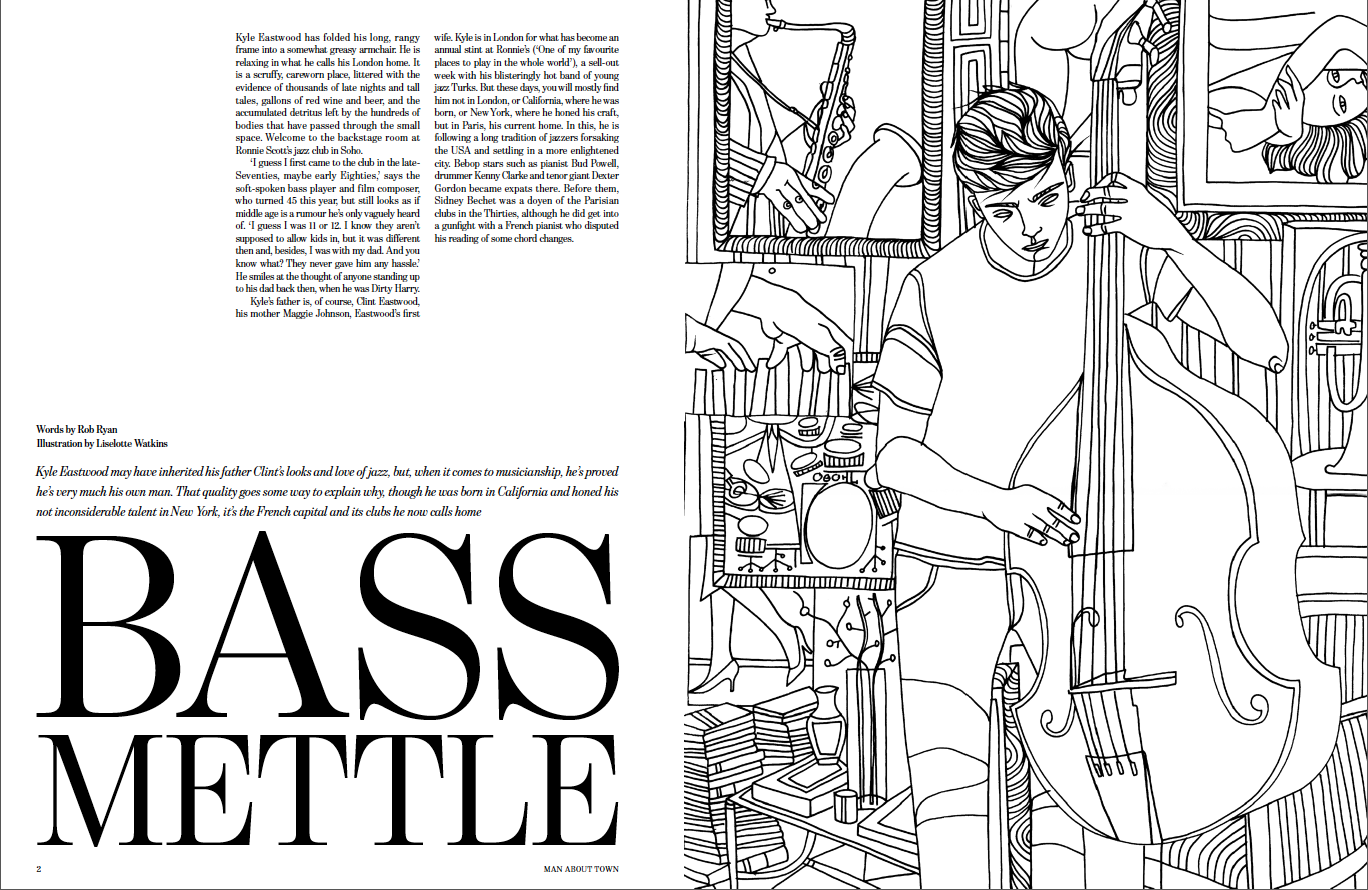
The latest issue of Man About Town features a piece by me about Kyle Eastwood, Clint’s bass-playing son, which includes a look at the history of jazz on Manhattan, as well as a recommended list of ‘Live in NYC’ jazz albums. Also what happened when Ken Clarke turned up to see Kyle play at Ronnie Scott’s. Plus a lovely illustration by Liselotte Watkins.
Screen Shot 2013-11-19 at 12.54.34

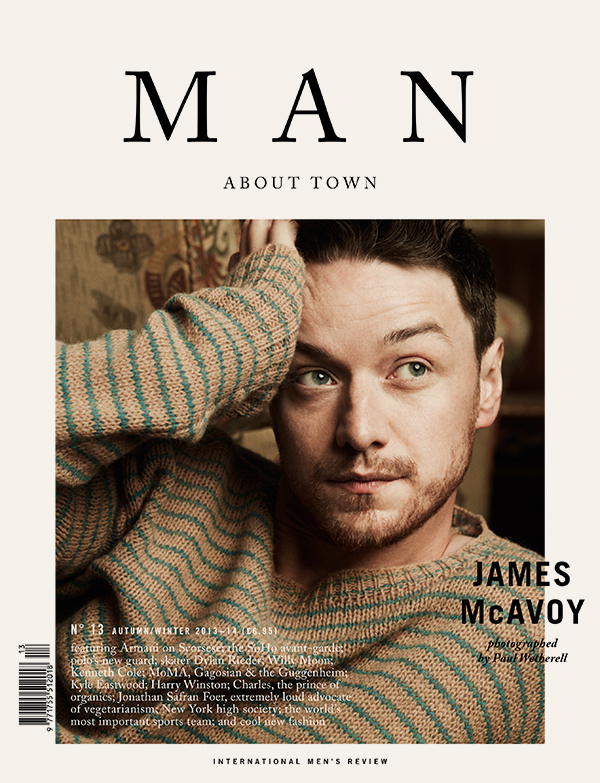
And you get James McVoy:

mat2See http://www.manabouttown.tv.

THE LYRICAL TRAVELLER: DON BLACK

Don Black, 75, has written the lyrics to more than 2,000 songs, including the Oscar-winning Born Free and the classic James Bond themes such as Diamonds are Forever and Thunderball, as well as for many theatre shows. He is currently working with Andrew Lloyd Weber on the musical Stephen Ward. A concert featuring his songs, Lyrics by Don Black, with the BBC Concert Orchestra and guest vocalists, is at the Royal Festival Hall on October 3 (www.southbankcentre.co.uk). He also has a Sunday morning show on Radio 2. Married with two grown-up children, he lives in London with his wife, Shirley. Here he talks to me about his travels.
But first watch David McAlmont/David Arnold’s brilliant version of Diamonds are Forever. Dame Shirley who?

DON BLACK: “I used to manage Matt Munro and we went round the world together. Everywhere, from Sao Paolo to Sydney. Didn’t see any of it. I’d say, Matt, Ipanema beach is out there, let’s go. He’d say: “Relax, it’s just sand, have a drink”. Or in New York, it’d be: Let’s go shopping up 5th Avenue and he’d reply: “Don, it’s Crown Court today and they’re giving the verdict. I’ve got to find a TV.” Hopeless. It was ironic he used to open his act with ‘Around the World.’ Like he’d know anything about it. I’m all for combining work and travel, but you have to get the balance right. Matt’s wasn’t.
I’ve just got back from Barbados, working with Andrew Lloyd Weber, who has a place there, and the balance was about right. I lie by the pool all day, scribbling a few ideas once in a while. Then Andrew sits at the piano and plays something and says: what do you think of this? And we’ll work on that for a bit. Perfect.
We used to go to Barbados every year when the children were young. We’d stay at Treasure Beach, which is right next to Sandy Lane, and it was always fun to watch my neighbor Michael Winner hold court on the beach, deciding who he would deign to talk to or not. The kids loved it, but one thing I have instilled in my children is the love of a good deli. No, really, what can beat a good corned beef sandwich with pickle? So we were in Barbados one year and the weather was awful and we were miserable. Then, a nest of some sort fell out of a tree and hit Shirley on the head. That was the last straw., I said: how about we go to Miami? The kids said – is the weather better there? I don’t know, I said, but they’ve got great delis in Miami. That was good enough, off we went for corned beef and pickle.
Mind you, Miami hasn’t got much else going for it. It’s nice, sure. I once stayed at the Delano, Madonna’s favourite, and I’ve never felt so old in my life. Miami’s OK if you are young, but beyond the party scene there’s no ‘there there’, as Gertrude Stein once said.
New York, though, is my favourite city in the world. You know you are alive – I love the energy and optimism. You can walk forever and never get lost, as long as you can count. And the Rodgers and Hart song sums it all up: ‘I’ll take Manhattan, the Bronx and Staten Island, too..’ Just going through the song is magic.
I know a lot of the appeal is nostalgia, but it gets me every time. I used to love the Waldorf Astoria, for instance, but I’m sure that was partly because it has Cole Porter’s piano.
I also had some the very best times of my life in Las Vegas, although it’s changed. When I went I saw Sammy Davies Jr and Dean Martin and Frank Sinatra. Incredible entertainers. Now it’s all shows like Cirque du Soleil and fancy illusionists, which isn’t quite the same. And I suppose I should mention Los Angeles. We used to live there but I went back recently for a James Bond 50th anniversary tribute. Stayed at the Four Seasons, had dinner with the Broccolis – a little work mixed with pleasure, very nice. But LA is the capital of showbusiness – it’s great to visit if you are in the business, not so much if you aren’t. As someone said, it’s the only city where you can die of encouragement, because there is no such thing as a bad meeting. There is a shallowness to it – but on the other hand you’ve got places like Route One to Big Sur and great weather. It’s hard to hate, really. I always look forward to going back.
Growing up in Hackney, we didn’t do holidays. A day trip to Southend was about it. I didn’t go abroad until I started work at the New Musical Express in Tin Pan Alley, Denmark Street – two hundred yards of hokum, as someone called it – meeting stars like Frankie Vaughan and Frankie Lane – old fashioned now, but the Robbie Williams of their day. Paris was my first trip out of the country and my first flight and I thought it was wonderful. Taking off and coming down over a necklace of twinkling lights. After that I became a stand-up comic for a bit and most of my travelling was to die in places like Bradford and Glasgow. I always say I wrote my first song while waiting for a laugh in Darlington.
I know this sounds terrible, but there aren’t many wonders of the world that would tempt me away, just to visit. Sightseeing doesn’t interest me and the thought of three weeks on a perfect beach would drive me mad. Besides, Shirley doesn’t swim. Shallow end in pools, only. The places I want to go to are towns like Sag Harbor, where Hemingway went to write. I’d like to copy that. And New England. I read a lot of poets like Edna St Vincent Millay, who was born in Maine, and Robert Lowell, who was from Boston, a city I would love to visit. I get this world of diners and liquor stores from them and, although it might have gone now, I’d really enjoy trying to find it.”

Dead Man’s Land with Alison Balsom

images-1
Alison Balsom (above, picture by Maker) won the Gramophone Artist of the Year this week – a hugely prestigious prize, made all the more special by her being the first female recipient. There has been some odd press about her and her marketing (‘trumpet crumpet’ is the cliche most often trotted out) in the past few months, most of which misses the point that she plays like a dream. Anyone who saw and heard her tackling the tricky natural trumpet in Gabriel at the Globe this summer won’t need convincing of that. Anyway, more of Alison will follow in this blog, but for the moment below is a sneak preview of a trailer for Dead Man’s Land (to be released on The Dark Pages, http://www.thedarkpages.com, next month), which features her beautifully toned trumpet, recorded at Abbey Road. Thanks to Alison, Vicki Corley-Smith, Bella Ryan, Guy Barker and Warner Classics for this.

A Few Thoughts On @lovesupremefest

There was some carping that Chic didn’t belong on the bill at the Love Supreme Festival last weekend. A disco band at a jazz festival? Yet, both Nile Rodgers and his late partner, Bernard Edwards, came from a jazz background, as Niles demonstrated with some Wes Montgomery-style noodling while getting the sound right. Furthermore, it’s hard to tell how many of the 7,500 a day tickets he and his Daft Punk/Glastonbury connection added but, along with an accurate forecast for glorious weather, it must have been significant.

IMG-20130706-01112

Certainly, the very youthful faces in Chic’s crowd (who could just about place Let’s Dance as a Bowie record) weren’t there because of Chic’s heyday, but they were a welcome dilution of the usual jazz demographic. Poor Portico Quartet suffered in the nearby Arena, being swamped by the tsunami of slap bass and sing-alongs, Brass Jaw were equally outgunned by an exuberant Soweto Kinch, although they later gave an nicely impromptu al fresco blow to make up for it. Next year (we are promised at least three Love Supremes), the proximity of the Arena to the main stage needs to be looked at. As does the car parking – some marker boards so you can locate your vehicle in the middle of a field in the dark would help. But, a few gripes apart – is there any way to prevent ridiculously lengthy peak-time beer queues at a festival? – ALS was a very creditable inaugural effort. One thing I liked was that it was small and comfortable enough that you could always get close enough to the stage to look the artists in the eye – so there was no need for the giant screens of larger gatherings. Plus there was fine music, with notable performances from Snarky Puppy – not so much snarky as rabidly good – Gregory Porter (below), whose star continues to shine brighter and brighter,

Porter1._JPG Go Go Penguin, Michael Kiwanuka, Terence Blanchard, Troyka and Neil Cowley (due to clashes/tennis/interviews I missed several acts, including Esperanza Spalding, who sounded in fine form, and Melody Gardot). John Fordham in his very fair Guardian review (www.guardian.co.uk/music/2013/jul/07/love-supreme-festival-review) didn’t seem to mind Bryan Ferry, but I thought, as accomplished as his Jazz Age band was at evoking the ‘20s/30s, it was all just plain weird, especially when his guitarist appeared to shred things up a little. Overall, though, A Love Supreme is well worth booking a slot for next year. Let’s hope the sun thinks so, too.

See also John L Walters’ opinion at http://bit.ly/10IBzIx .

GUY BARKER/KURT ELLING/JANIE DEE ON LISTEN AGAIN

That Obscure Hurt, which premiered at Snape Malting, on June 12  is on iPlayer, here:

http://tinyurl.com/pdv53e5

The programme notes are below this post.

And here is Kurt Elling in rehearsal at Maida Vale Studios:

photo

You can just make out the great Italian alto player Rosario Giuliani behind the pianist (that’s Jim Watson on the keys, who has been playing with Manu Katché) and to Rosario’s left is Benjamin Herman, also on alto, also a great sax man and winner of the Dutch GQ Best Dressed Man Award.

And at Snape Maltings the stage looked like this (again at rehearsal; photograph by Laura Mitchell). The BBC Concert Orchestra on the left, Guy Barker jazz Orchestra on the right.

GuyBarker12June (1) LMitchellWhat the radio couldn’t show you was the funky frugging of Janie Dee in her slinky backless dress during the Powder Monkey reprise. I think admissions spiked at the cardiac ward in
Ipswich afterwards, as pacemakers overloaded among the audience.

For Those Listening To Radio 3 @ 7.30pm Tonight

These are the notes the audience at Snape will have as a guide to the piece’s structure. It is based on The Jolly Corner by Henry James, but is set on a Transatlantic ship, New York in the late ’40s and Soho present day. Spot the Benjamin Britten references (because there’s none in the music).

THAT OBSCURE HURT.

Music by Guy Barker.

PART ONE.  Prologue: An Atlantic Overture.

Early 1950s. The English musicians of Geraldo’s Navy arrive at the docks in awe at the size of their ship, the SS Lucretia. As they board the ship, the captain and the crew bark at the disorientated new hands, sending them this way and that, looking for their cabins, their instruments, their gig and then, as they set sail into rough seas, the newcomers try unsuccessfully to find their sea legs. Eventually, they locate their berths and settle into work and, over the sounds of the ocean, we hear the strains of the dance band and we find ourselves momentarily in the Verandah Ballroom before the skyline of Manhattan makes in appearance. The excited musicians drop their instruments and scuttle ashore. They take in the sights, sounds and throbbing energy of the city – exciting and intimidating in equal measure. They find themselves on 52nd St.

PART TWO. Prince At the Pagoda.

Early 1950s. The jazz club on 52nd St where the musicians listen in rapture to host Harry Prince as the band plays a roaring be-bop piece that incorporates passages from the solos of the great modern jazz maters of that era: Bud Powell, Fats Navarro and even a four-bar quote from Dizzy Gillespie’s “Ow”.

PART THREE. In Darkness.

Present Day. Spencer Bryden is watching CCTV from a remote location and sees the ‘ghost’ haunting his club (Gordie’s or AMJG) in Soho, London. An account of the encounter is read out by Jennifer Muldoon, an investigator into psychic phenomena.

PART FOUR. Opus 50/ A Time There Is

Present Day. Spencer, still reeling from the images he saw on the CCTV, visits the Soho jazz club (Gordie’s, above) he inherited from his father, which is in its final week of operation before its proposed sale.  Harry Prince Jr – the son of the man Spencer’s father saw in NYC all those years ago – sings a song about the passage of time.

PART FIVE. Powder Monkey.

1960s flashback. Harry Prince Jr, with a little help from Alice Staverton, the club manager, evokes the sounds of the club in its sixties heyday.

PART SIX. Notturno.

Spencer is alone in the club after hours, the room silent and deserted, the tables with empty glasses, the walls slick with 60 years of smoke and sweat and the echo of all the music that has been played and is about to disappear forever.

PART SEVEN. A Kind of Ghost.

Spencer becomes aware he is not alone. He glimpses a figure. He chases him backstage, terrified but determined to confront the spectre. But the ghost doesn’t want to be caught – it is elusive and playful, giggling, darting and dancing (in one instance to a tango) through the club, shredding Spencer’s already taut nerves, until, finally, an exhausted Spencer manages to corner the phantom. When he finally does confront the ‘ghost’, he realises he is looking at a different version of himself. This was the terrifying image he saw on the CCTV.  This is the man he would have been, had he not left London for exile. But this ghost is suffering – he has cancer, is constantly chewing nicotine gum to suppress the urge for the cigarettes that have killed him. He has come to warn Spencer. And enlighten him.

PART EIGHT. I Hid My Love.

Spencer reels yet again at the revelations from his other self (musically, the brass chorale in Opus 50 reappears, but this time played on the strings). The ghost departs and Spencer discovers cans of old film from the days when his father was alive. He plays the super-8 movies and sings a song about the love of his father (and Alice), and how he denied it. This piece is designed to echo ‘the sounds of the era of ‘The Great American Songbook’.

PART NINE. Alice’s Gift.

Alice finds Spencer passed out in the club. She wakes him. He reveals what the ghost told him- that Alice has paid off the gangsters who had been threatening him and that she has saved the club – if he wants to keep it, he can. Alice makes a speech explaining herself and finally declaring her love for Spencer. He realises he has been a fool – he can have the club, and Alice too. With thanks to Henry James and his friend Edith Wharton.

PART TEN. Floods of Noise.

The spirits of every musician who has ever played the club celebrates including a reprise of Powder Monkey.