The Tom Smith Big Band plays at the Pizza Express at lunchtime on Sunday October 5 (https://www.pizzaexpresslive.com/whats-on/the-tom-smith-big-band). This is a very classy ensemble of top players and Tom is a talented arranger and composer – praised by one of his influences, my friend and collaborator Guy Barker – who writes evocative themes and charts for his stellar soloists to shine over. Check out his album A Year in the Life, a first rate jazz ode to London, which includes players of the calibre of saxophonists Graeme Blevins and Alex Garnett and trumpeters Tom Walsh and Freddie Gavita. I asked Tom Smith at the time of his last Pizza gig if you had to be crazy to run a big band in this economic climate, given the challenges of pulling together so many in-demand players. This is his Big Band Theory.

“You’re right that it’s a huge job, but there is something absolutely mesmerising about watching a group of 18+ musicians working together in harmony. Anyone who’s seen a big band performing live will know this immensely, especially in London where you can get right up and close to the performers and feel every note in your bones. In this country we really do have some of the finest big band musicians in the world – musicians who’ve studied this music all their life inside and out and know exactly what to do to elevate it to the highest level. There is a huge appetite in this country to experience this music, and we are in a new age of big band composers, especially in this country – Nikki Iles, Julian Siegel, Emma Rawicz, Dan Casimir, Sean Gibbs, Charlie Bates/Helena Debono, Callum Au, Olivia Murphy, Josephine Davies..and I could go on, everyone approaching it from totally different angles, with so much experimentation and new ideas.
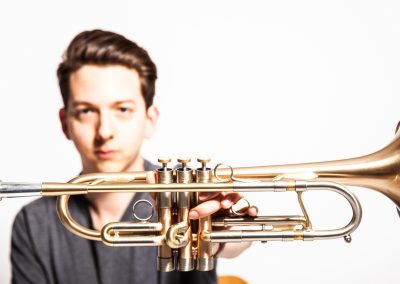
“For my money the classic big band line-up is one of the all-time great large ensembles for the simple reason that it’s a self-balancing acoustic ensemble. In the hands of experienced players 5 saxes, 4 trumpets, 4 trombones, piano, bass, drums and guitar can perfectly balance with each other without the need for amplification, and this gives the musicians and the composer a HUGE amount of control over how the music is expressed and played. We also have access to a huge number of timbres – the saxes can be harsh, melodic, airy, trumpets bombastic and regal, trombones piercing and full bodied, and that’s not to mention the extra colours we can get with mutes, moving the saxes onto flutes and clarinets, and giving the trumpet players flugelhorns. The rhythm section is very adaptable and wide ranging, giving you the option to move from 20s jazz to 60s rock, from psychedelic guitars and orchestral percussion. The greatest big bands in the world consistently sell out huge concert halls, and I see a future where the big band is regarded as equally as important as a full classical orchestra – my dream is to write a film score using a big band as my main writing vehicle! (Below: Freddie Gavita).
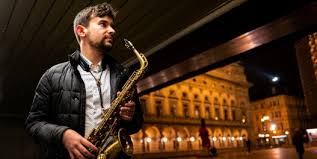
“What I love about being a saxophone soloist on top of a big band is the amount of support it gives you. The music has a great range of movement, timbres, emotional weight and texture and this gives me so much to work with. I find myself playing off of the most different things every time I play with the band – the way a specific trombone chord resonates at a certain point, the sound of a muted trumpet playing with a clarinet can inspire me and push me in new unique ways each time. I absolutely love playing in smaller groups as well, there’s more options for where the music can go and your improvisations can move into freer territories, but sometimes the magnificence of a well-oiled machine like a big band is hard to beat…”
And if that doesn’t whet your appetite for some of Tom’s big band adventures, I don’t know what will.
 robtryan