Another day, another sold out show, another slice of Mr Miles Davis. Last week Ronnie Scott’s in Soho saw the impressively versatile multi-instrumentalist, beat mistress and producer Emma-Jean Thackray paying her own homage to the master. Unlike Theo, Leeds’ finest did speak to the audience, explaining that she came through a northern brass band tradition, where everyone everywhere played the piece of music memorably called Concerto de Orange Juice by Pete Postlethwaite in the film Brassed Off. As a young teenager E-J T was on Limewire, which was mostly used for illegal file-sharing. She wanted to download a classic version of Rodrigo’s piece to practice along to. Instead, she got the one from Miles/Gil Evans Sketches of Spain and a new passion was born.
In fact, rather than being “Dear Miles – A Love Letter to Miles” as billed the evening was really Miles & Me, charting the ongoing relationship between the two trumpeters. Although Electric Miles is closest to her heart, we were treated to tunes from many stages of Miles’ career, all processed through Emma-Jean’s magpie mind and broken beat sensibilities. We had a tricksy, staccato Seven Steps to Heaven, a So What welded to a monstrous jazz-rock groove, the bass heavy superfunk of One and One from On the Corner and a short, marvellously chaotic free section that suggested Miles channelling Lester Bowie or Don Cherry, But there were also moments of tenderness, notably from a Harmon mute and piano combo (kudos to Lyle Barton on keys for slipping into the Bill Evans’ shoes). For the finale she said “I had a dream about Miles. I dreamt he came up to me and whispered: I love jungle.” You can imagine what followed – a machine-like explosion of urban rhythms that sounded like Miles hanging out in a hip East London jazz/vinyl joint. The jazz police would probably say “you’re under arrest” and certainly baulked at this collision of cultures, but it certainly fired some electric London club vibes through Ronnie’s. Emma-Jean told us that the Guardian once described her as a “jazz chav”. Huh. “Jazz alchemist” more like. The next chance to catch her (although not this show; she has her own stuff to do) is at the Cheltenham Jazz Festival over the May Bank Holiday. See: https://www.cheltenhamfestivals.org/events/emma-jean-thackray. However she is performing the Miles show at EartH Hackney on November 13 as part of the EFG London Jazz Festival (tickets: https://efglondonjazzfestival.org.uk/events/emma-jean-thackray-dear-miles-a-love-letter ).
An expanded version of this piece will appear in the Camden New Journal.
Theo Croker’s “Miles Davis Mixtape”
Southbank Centre x Montreux Jazz Festival Residency. Royal Festival Hall. 13 March 2026
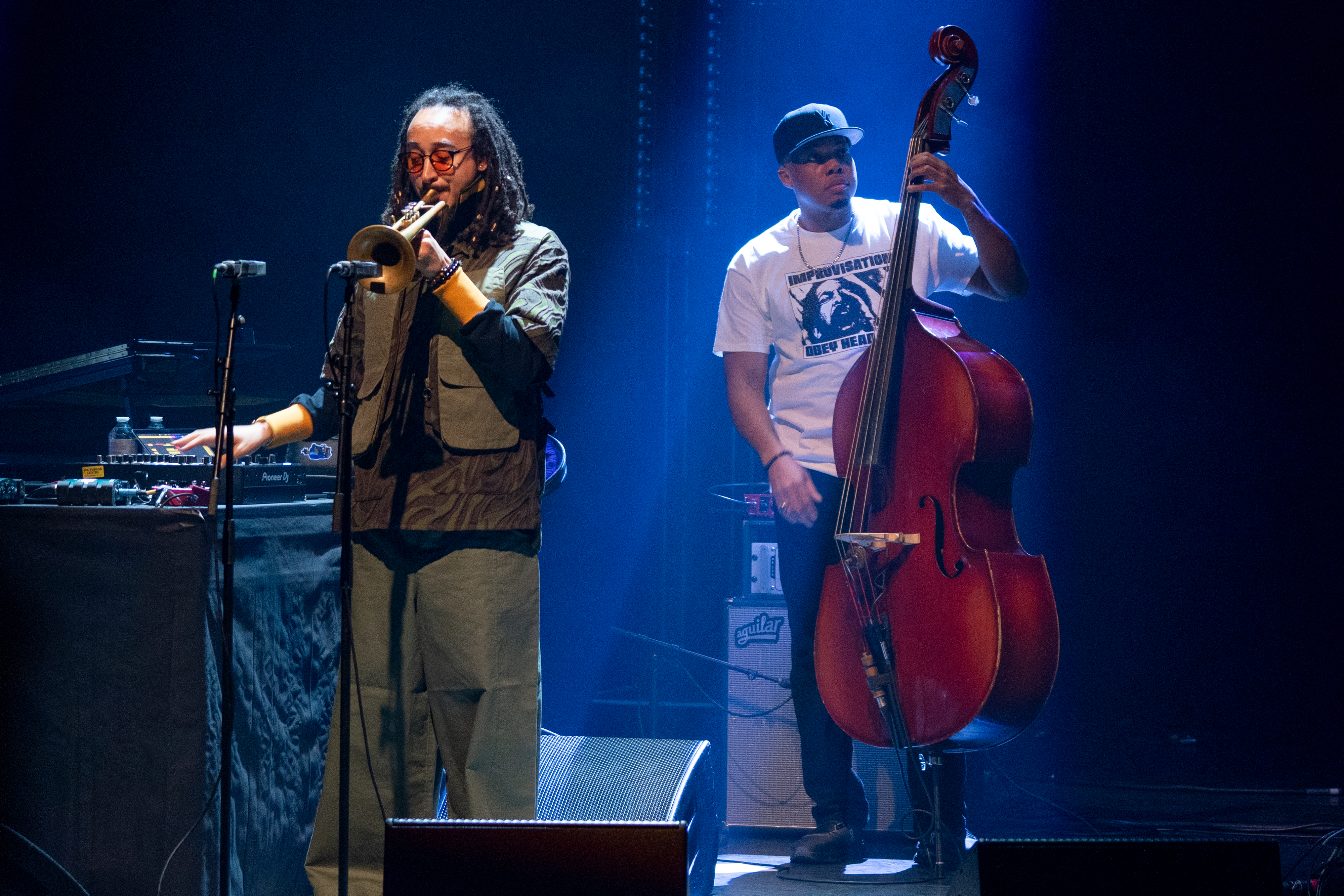
“I’m not going to talk very much,” announced Theo Croker near the start of his Royal Festival Hall concert, before adding, with a chuckle, “Miles didn’t talk much.” Which is, of course, very true – in his later years you were lucky if the trumpeter even looked at the audience. This non-speaking gig was a double celebration – of Miles Davis’ centenary and of a collaboration between the Southbank and the venerable Montreux Jazz festival, which came to town for the weekend. There was lots going on but – for me at least- Theo and Miles was the centrepiece.
(Photo: Pete Woodhead) The concert began with a beautifully full toned Concert de Aranjuez from the Gil Evans-helmed masterwork Sketches of Spain. Miles used a flugel in the opening on disc; Theo has a Monette trumpet, but no matter – that horn sings. It soon became clear that the pure-voiced singing was going to just part of its role here, as delay and reverb (Croker used a double microphone set up), scrunchy electronics and voice samples came to the fore as the Rodrigo segued into Croker’s own 4Knowledge. This was no slavish reproduction of Miles’ music, but a Theo Croker “mixtape”, with all the experimentation that suggests from a man who is one of the best and most forward-facing of the current crop of trumpeters. He included a good number of his own compositions in the mix – notably Amen Waters (where his playing reminded me of that other Miles admirer, Mark Isham) and 64 Joints, which is from his last album Dream Manifest. And they fitted perfectly.
So, those hoping for Kind of Blue played in its entirety were destined to be disappointed, but we did get some exhilarating deep cuts. Very deep, one of them being Yaphet from the underrated Big Fun album from 1974, a pulsing track which could have acted as a blueprint for the whole gig. The band were on top form as it essayed the changes in tempo, atmosphere and harmony while Croker manipulated the sound in real time. Eric Wheeler was a powerhouse on bass, young drummer Koleby Royston subtle and far from overwhelmed by the demands of the ever shifting soundscape and Tyler Bullock was on keys. Although the latter also played synths, he also gave us some welcome, energetic passages on acoustic piano that offered us a definite human touch amid the electronic processing.
(Photo: Pete Woodhead).
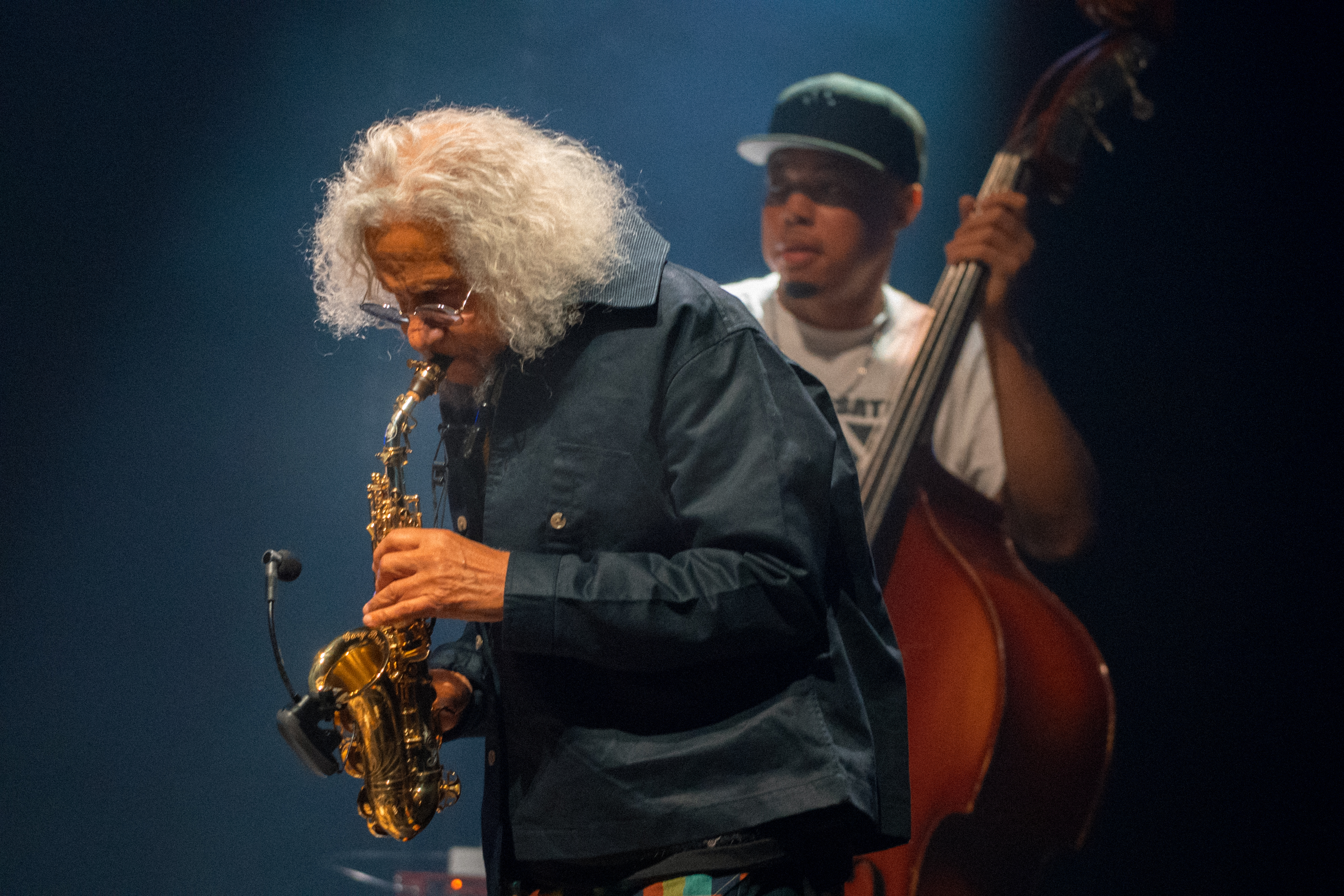
But it was special guest Gary Bartz who often took the limelight and ran with it. Looking like he had based his hairstyle on Doc from Back to the Future, the 85-year old began his contribution a little tentatively. I was a little concerned, as I have seen my fair share of jazz vets who no longer had the chop for a full-blown concert experience. No so Gary, who played with Miles in the early seventies (see Live-Evil) and led a pioneering fusion band called Ntu Troop (you’ll probably know Celestial Blues), and who showed here that he had the power and energy of a player half his age. Guest singer Ego Ella May also acquitted herself beautifully on two songs, including Croker’s Somethin’ which she sang on his album By the Way. I could have listened to more – but I guess I’ll have to catch one of her solo gigs.
The concert ended back on solid Miles ground with Wayne Shorter’s Water Babies and a tender, acoustic Round Midnight that raised a few hairs on my neck, before Croker had the last word with his Hero Stomp. A couple of the two thousand plus audience expressed disappointment to me over a post-gig drink (they’d seen me taking notes) at the Croker-to-Miles ratio and the treatment of the sound. As someone who got on board with Miles at around Bitches Brew, I enjoyed the sonic manipulation which seemed entirely appropriate. After all, plenty of Miles’ music was heavily restructured in the studio by producer Teo Macero (look at the number of tape edits on the In a Silent Way album). I gave them my considered verdict on Theo’s mixtape: Miles would have loved it.
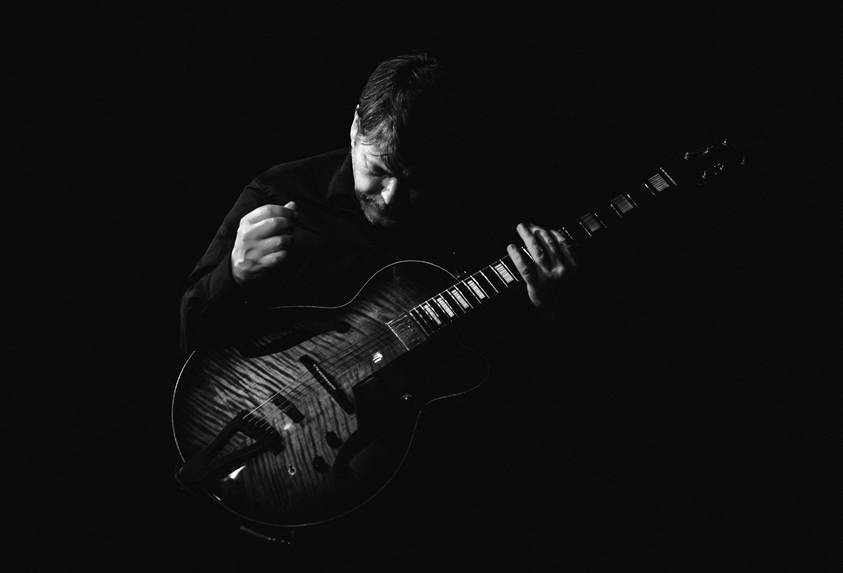
I fully intend to write about guitarist Nigel Price and his new album in my next column for the Camden New Journal, but I know I simply won’t have room to do him justice. Not only is Price our finest interpreter of the legacy of Wes Montgomery, Kenny Burrell and (pre-pop) George Benson, he has been instrumental in maintaining the health of jazz in Britain.
(Above: Nigel Price. Photo by John McMurtrie)
We in London tend to think that jazz revolves around Ronnie Scott’s, the Pizza Express, The 606, The Vortex, The Jazz Cafe and a handful of other venues. These might form the beating heart of British jazz, but the lungs, the organ that keep the music breathing, is found in the myriad of small clubs scattered around Britain. They act as incubators for new talent that will find its way to London eventually, but also offer a network where established players can always get a gig. Without the likes of Peggy’s Skylight in Nottingham, The Verdict in Brighton, Splash Point in Seaford and Eastbourne, the Bear Club in Luton, the Band on the Wall, Manchester, Jazz Jurassica, Lyme Regis, Palladino’s in Cardiff, the Blue Lamp, Aberdeen and many, many more, the life of a gigging jazz musician would be even more unsustainable than it is in the current climate, where rapacious Spotify has stripped out much of the traditional income stream.
These clubs are often run by enthusiasts and volunteers who wouldn’t recognise the word profit if it was on a Scrabble board before them (11 points by the way). Such is the precariousness of their existence that Covid threatened to kill some off as efficiently as it did those in care homes. It was why Price set up the Grassroots Jazz charity (https://www.grassrootsjazz.com), which fundraises and gives grants directly to venues. Recipients have included St Ives Jazz Club; Sound Cellar, Poole; Bebop Club, Bristol and Milestones, Lowestoft. Quite why he hasn’t been given some kind of government-sponsored gong for Services to Jazz is beyond me (although he and his group have won plenty of awards over the years).
His latest tour is with his Organ Trio to showcase the band’s new record It’s On! It is criss-crossing the country, calling at many of those self-same grassroots venues outside of London (although for those in the capital there’s an album launch at Pizza Express Soho on October 5th – https://www.pizzaexpresslive.com/whats-on/nigel-price-organ-trio). For the full list of gigs nationwide see https://nigethejazzer.com/.
It’s On by the Nigel Price Organ trio is a very good album indeed – he’s not just a fine guitarist but his fellow members (Ross Stanley on Hammond, Joel Barford on drums) are at the top of their game. The hefty touring schedule that the trio undertakes has given them real emotional, rhythmic and harmonic connection. In his sleeve notes the guitarist calls the collection of tunes on It’s On! a “mixed bag” but it’s a cohesive exploration of classic organ trio material, re-written, reworked and revamped by Price to give it a more modern feel, while not ignoring the voicings and killer swing that made guitar/organ/drums such a key feature of the jazz repertoire. Buy a physical copy if you can rather than streaming it. You can purchase It’s On! and his other records on vinyl and CD at Price’s website above. And then catch the trio live and help keep jazz in Britain breathing.
The Tom Smith Big Band plays at the Pizza Express at lunchtime on Sunday October 5 (https://www.pizzaexpresslive.com/whats-on/the-tom-smith-big-band). This is a very classy ensemble of top players and Tom is a talented arranger and composer – praised by one of his influences, my friend and collaborator Guy Barker – who writes evocative themes and charts for his stellar soloists to shine over. Check out his album A Year in the Life, a first rate jazz ode to London, which includes players of the calibre of saxophonists Graeme Blevins and Alex Garnett and trumpeters Tom Walsh and Freddie Gavita. I asked Tom Smith at the time of his last Pizza gig if you had to be crazy to run a big band in this economic climate, given the challenges of pulling together so many in-demand players. This is his Big Band Theory.
“You’re right that it’s a huge job, but there is something absolutely mesmerising about watching a group of 18+ musicians working together in harmony. Anyone who’s seen a big band performing live will know this immensely, especially in London where you can get right up and close to the performers and feel every note in your bones. In this country we really do have some of the finest big band musicians in the world – musicians who’ve studied this music all their life inside and out and know exactly what to do to elevate it to the highest level. There is a huge appetite in this country to experience this music, and we are in a new age of big band composers, especially in this country – Nikki Iles, Julian Siegel, Emma Rawicz, Dan Casimir, Sean Gibbs, Charlie Bates/Helena Debono, Callum Au, Olivia Murphy, Josephine Davies..and I could go on, everyone approaching it from totally different angles, with so much experimentation and new ideas.
“For my money the classic big band line-up is one of the all-time great large ensembles for the simple reason that it’s a self-balancing acoustic ensemble. In the hands of experienced players 5 saxes, 4 trumpets, 4 trombones, piano, bass, drums and guitar can perfectly balance with each other without the need for amplification, and this gives the musicians and the composer a HUGE amount of control over how the music is expressed and played. We also have access to a huge number of timbres – the saxes can be harsh, melodic, airy, trumpets bombastic and regal, trombones piercing and full bodied, and that’s not to mention the extra colours we can get with mutes, moving the saxes onto flutes and clarinets, and giving the trumpet players flugelhorns. The rhythm section is very adaptable and wide ranging, giving you the option to move from 20s jazz to 60s rock, from psychedelic guitars and orchestral percussion. The greatest big bands in the world consistently sell out huge concert halls, and I see a future where the big band is regarded as equally as important as a full classical orchestra – my dream is to write a film score using a big band as my main writing vehicle! (Below: Freddie Gavita).
“What I love about being a saxophone soloist on top of a big band is the amount of support it gives you. The music has a great range of movement, timbres, emotional weight and texture and this gives me so much to work with. I find myself playing off of the most different things every time I play with the band – the way a specific trombone chord resonates at a certain point, the sound of a muted trumpet playing with a clarinet can inspire me and push me in new unique ways each time. I absolutely love playing in smaller groups as well, there’s more options for where the music can go and your improvisations can move into freer territories, but sometimes the magnificence of a well-oiled machine like a big band is hard to beat…”
And if that doesn’t whet your appetite for some of Tom’s big band adventures, I don’t know what will.
Guy Barker’s Inferno 67 finished a sold-out three-night run at Ronnie Scott’s last night (Sep 19th). I wrote the “book” and Joe Stilgoe the lyrics, but the heart of the piece is Guy’s music for his 18-piece big band, which almost fitted on the stage. The sheer stamina demanded of the players for this 75-minute epic (which features barely five minutes of silence from them) is astonishing. As is Per “Texas” Johansson who came from Stockholm with his contrabass clarinet to make some amazing sounds and growls. And the trumpets… normally there is a lead trumpet, then a second, third etc… here there were five leads, all trading places. The power generated was intense but sound engineer Miles Ashton ensured there was amazing clarity in the mix – it was possible to isolate individual players within the soundscape..
The show also included Vanessa Haynes singing Headshrinker/Voodoo Working, two old soul classic from the sixties, and Have a Nice Life, lyrics by Joe, music by Guy, which needed someone of Vanessa’s skill and power to do it justice. She smashed it every night. Here she is with Guy conducting. Costume singer’s own.
Danny Sapani played the narrator but also “rapped” as Little Albert, singer at the nightclub Hell on Earth.
And as well as supplying lyrics, Joe Stilgoe was the MC of Hell on Earth, Joey Darke.
Above is actress and writer Emer Kenny who played the enigmatic Cassandra with (the back of – sorry) Demetri Goritsas who is a heartbroken cop who falls in love with Cassandra. Shame she’s a Memetim, an avenging angel (check your bible, Book of Job). That’s a shrunken head she is admiring.
Also playing a starring role…
Yes it is quite a complex plot, but really its just a love story with added complications – like immortality. And Irish whiskey.
Thank you to http://www.ronniescotts.co.uk / @officialronnies for having us and taking a chance on a very different type of show for the club. and for the above pictures There’s even a rumour we might do it again next year…..
Composer-arranger-conductor and let us not forget trumpeter Guy Barker and myself have collaborated on several large scale jazz projects over the years. There was The Amadeus Project featuring dZf, a cheeky Runyonesque re-working of The Magic Flute, featuring actor Michael Brandon as the gravel-voiced narrator. For a Benjamin Britten festival at Aldeburgh we created That Obscure Hurt, a 90-minute piece for 75 musicians, with the great American singer Kurt Elling and actress Janie Dee. As a co-commission with the RTE (he is its Associate Artist) and the BBC Concert Orchestras, Guy created bravura new arrangements of Charles Mingus’s music to a text written by me and spoken/sung by Allan Harris.
But Inferno 67 is something else, as you can tell from this ad in the latest edition of Jazzwise:
My instruction from Guy was to imagine an episode of the Twilight Zone as if directed by David Lynch and scored by Quincy Jones, Miklos Rosza, Bernard Herrmann and Johnny Dankworth. And maybe the Beatles. And definitely Coltrane. That was before the pandemic. Since that enforced hiatus, it has grown in scope, introducing new characters, references and twists and is now blessed with one hell of a score. Luckily the powerhouse Guy Barker Big Band, its ranks filled with world-class soloists, can manage every switchback that its titular leader can throw at them.
So that just left the story element to deal with. For the narrator, Guy recruited the wonderful Clarke Peters (The Wire, Five Guys Named Moe, etc etc) and for lyrics, wit and devilish charm, the urbane Joe Stilgoe. The firebrand soul and funk come from the incomparable Vanessa Haynes; the shape-shifting love story is delivered by two of the UK’s top actors – Demetri Goritsas (whom I had seen in the fabulous “Jaws” play The Shark is Broken, as Roy Scheider) and Emer Kenny, who, among many other things, wrote the screenplay and co-starred in the series Karen Pirie, based on the novels by Val McDermid.
So, in all, that’s about 22 people on stage. It’s fair to say Ronnie Scott’s has rarely seen anything like it, but rest assured, the beating heart of this piece is the finest big band jazz in all it iterations. And a bottle of Green Spot whiskey. Oh, and a shrunken head. You’ll just have to go to find out why.
Over the years we have had Art Blakey’s Jazz Messengers, Ronnie Scott and Tubby Haye’s Jazz Couriers and the pioneering Jazz Warriors with Courtney Pine, Gary Crosby etc. from South London. Now, from Bristol, we have the Jazz Defenders. Given that jazz has probably never been so popular in this country, what exactly are they defending? Well, not the art form as a whole, but one important corner of it – the soul-jazz movement of (mostly) the sixties, with records such as Lee Morgan’s The Sidewinder, Horace Silver’s Song for my Father Hank Mobley’s No Room for Squares and Herbie Hancock’s Takin’ Off (which included Watermelon Man) or the under-rated Fat Albert Rotunda.
Purists were disparaging about many of the soul-jazz albums at the time, seeing them as a cynical ploy by Blue Note and other labels to sell more records on the back of the surprise success of The Sidewinder and, in the parlance of the time, “selling out” (there was some truth in this – records like Lee Morgan’s kept the label alive). Fortunately, “jazz” is a far broader, less judgemental church than it was, and original pressings of the once derided discs are now much sought after by collectors. And the musicians in The Jazz Defenders are too young to recall the hostility from the pages of Downbeat magazine.
In any case, the Jazz Defenders definitely have this side hustle’s corner. From the opening blast of unison horns from the frontline courtesy of Jake McMurchie on sax and Nick Malcom on trumpet, the audience knew they were in safe hands – these guys have this music down tight. Furthermore, they’re not a slavish tribute band, the tunes are all original compositions, which may have a rhythmic familiarity but with a modern melodic sensibility at work. There is even a blast of hip hop thanks to the special guest, the actor and rapper Doc Brown who offered a sparky, witty interlude with Rolling on a High (he should have a way with words – he is Zadie Smith’s younger brother). There was also welcome hints in the mix of Quincy Jones’s soundtrack work – think the muscular Theme from Ironside and the frothy Soul Bossa from the Austin Powersmovies.
Leader George Cooper – who moved house to London on the day of the gig – has played across the musical spectrum, having worked with Hans Zimmer, Nigel Kennedy, U2, Omar, Slum Village, MF Doom and The Brand New Heavies. It is little surprise that he can switch effortlessly between Herbie-like electric piano, classic Jimmy Smith Hammond B3 (albeit on a sound-a-like keyboard rather than the real beast) and, later, perform a lovely chamber piano piece called Enigma, which summoned up the spirit of Mehldau and Jarret. Kudos too to the powerhouse drummer Ian Matthews, whose “other band”, as he put it, is Kasabian. I asked him about being (like Charlie Watts) a rock drummer who loves and plays jazz. “They’re very different experiences,” he said, wheeling out a boxing analogy. “One is like punching haymakers, the other is more jabbing and fancy footwork.” So, one George Foreman, the other Muhammed Ali. In fact, given his ferocious final drum solo, it is obvious Matthews can bring a few Foreman haymakers to the party at any time.
The night’s repertoire was mainly drawn from the band’s latest album Memory in Motion (Haggis Records), with a sprinkling of tracks from the previous King Phoenix, including Munch, where taut acoustic bassist Will Harris switched to electric for a slice of infectious dirty funk. Live, the tunes are perhaps more full-blooded than on record, thanks to the vigorous soloing of McMurchie and Malcolm and the driving drumming from Matthews, but the album is worth investigating as it works on several levels. Given its lack of jazz dissonance and because it flirts with funk, soul and R&B, it can work as quality background music, but pay closer attention and the high calibre of the playing and writing draws you deeper into what is a very satisfying and rewarding set of soul-jazz in all its iterations. I would say the record (and the band live) is a perfect gateway drug for any jazz-averse friends you might have. This stuff burns.
On the wall behind me at the Pizza Express was a poster for guitarist Barney Kessel playing the venue, presumably back in the Sixties. It reminded me that I had been meaning to recommend an album by an Irish guitar player who cited Kessel (and Joe Pass and Wes Montgomery) as influences. Unlike the UK, Ireland in the sixties and seventies did not have a large pool of internationally recognised players, perhaps because the Catholic church long waged a campaign against the devil’s music (there were even anti-jazz parades in some towns and cities in the 1930s). Louis Stewart was an exception, a guitarist who played with Tubby Hayes and whom Ronnie Scott rated as one of the best in the business (unconditional praise from Ronnie was as rare as one of his new jokes). Stewart’s debut album (Louis the First) from 1975 has just been re-issued by Livia Records and it sounds wonderful. Straight out the gate with an energetic All The Things You Are, the listener agrees with Ronnie, this Irishman had the chops to play among the top guns. The album is all standards, sometimes tackled at quite a lick, but with remarkably precise playing from Stewart even at the fastest tempi. Mostly performed with his trio, there are also three solo pieces, one of which demonstrates how to take an old warhorse such as Send in the Clowns and breathe new harmonic life into it. Elsewhere his modern-sounding voicings remind me of when Larry Coryell parked his jazz-rock and played straight ahead jazz. Well worth investigating.
Stewart was also famed for a mischievous sense of humour. One story has it that, when he was ill in hospital, one of his relatives asked if, should the worst come to the worst, would the guitarist like to be buried or cremated? Stewart beckoned them closer and as they leaned in, he whispered: “Surprise me.”
AT the risk of name-place-dropping, I first met guitarist David Preston at Abbey Road Studios, where he was recording with Ian Shaw and the late, much-missed Peter Ind, the Gandalf of the acoustic bass. Preston came across as a quite shy and retiring young man but who nevertheless chose his notes with precision and intelligence. He still works with Shaw (he co-wrote much of the excellent Lifejacket album and is part of the Greek Street Friday album and live ensemble) but also has a thriving career as a sideman and most recently a solo artist.
No longer so shy and retiring (or quite so young – that Abbey Road meeting was back in 2010, which makes me Methuselah), the intelligence and commitment are still there, bolstered by instincts honed by years of gigging live. All this is well demonstrated on his Purple/Black Volume 1 album, the first under his own name, which features a top-of-the-range band in pianist Kit Downes, Kevin Glasgow on bass and Seb Rochford on drums.
It was designed, in his words, as an “in the room” dialogue between the individuals. It isn’t, as many jazz debut albums are, a showcase for speed or stamina or the ability to cram as many chord and key changes as is humanly possible into five frenetic minutes. It is for the most part more reflective than that, the touchstones, if you need them, being Bill Frisell, the more introspective side of Pat Metheny and perhaps early John Abercrombie. Although they are merely suggested to these ears, rather than overt influences.
Not that Preston & Co can’t bust out the chops – Cassino Dream, for example, features fabulously fleet-fingered interchanges between Downes and the leader. The album opens with O’Winston, a reference to the great American photographer of railroads, O’ Winston Link, and is intended to evoke the feeling of riding a train through the mountains in Virginia (it begins with an insistently hooky ostinato bass from Glasgow, at once prowling and probing).
The title track is built on Preston’s favourite power chords, but as with so much on the album, it subverts any expectations from that statement, being both doomy and optimistic.
There is much to enjoy here even for those who don’t normally like jazz guitar, and I found that the record reveals more delights with each listen, especially when you home in on what Rochford is up to, nimbly driving or supporting the other players. Incidentally, the last cut, the lovely, quietly twisty Susie Q’s, is not a celebration of a well-known bass-playing pop legend – that’s Suzi Q – but north London’s jazz wunderkid Jacob Collier’s mum.
You can hear Preston in a trio setting unveiling a new project at The Parakeet in Kentish Town on Monday 29th April. See https://jazzattheparakeet.com/
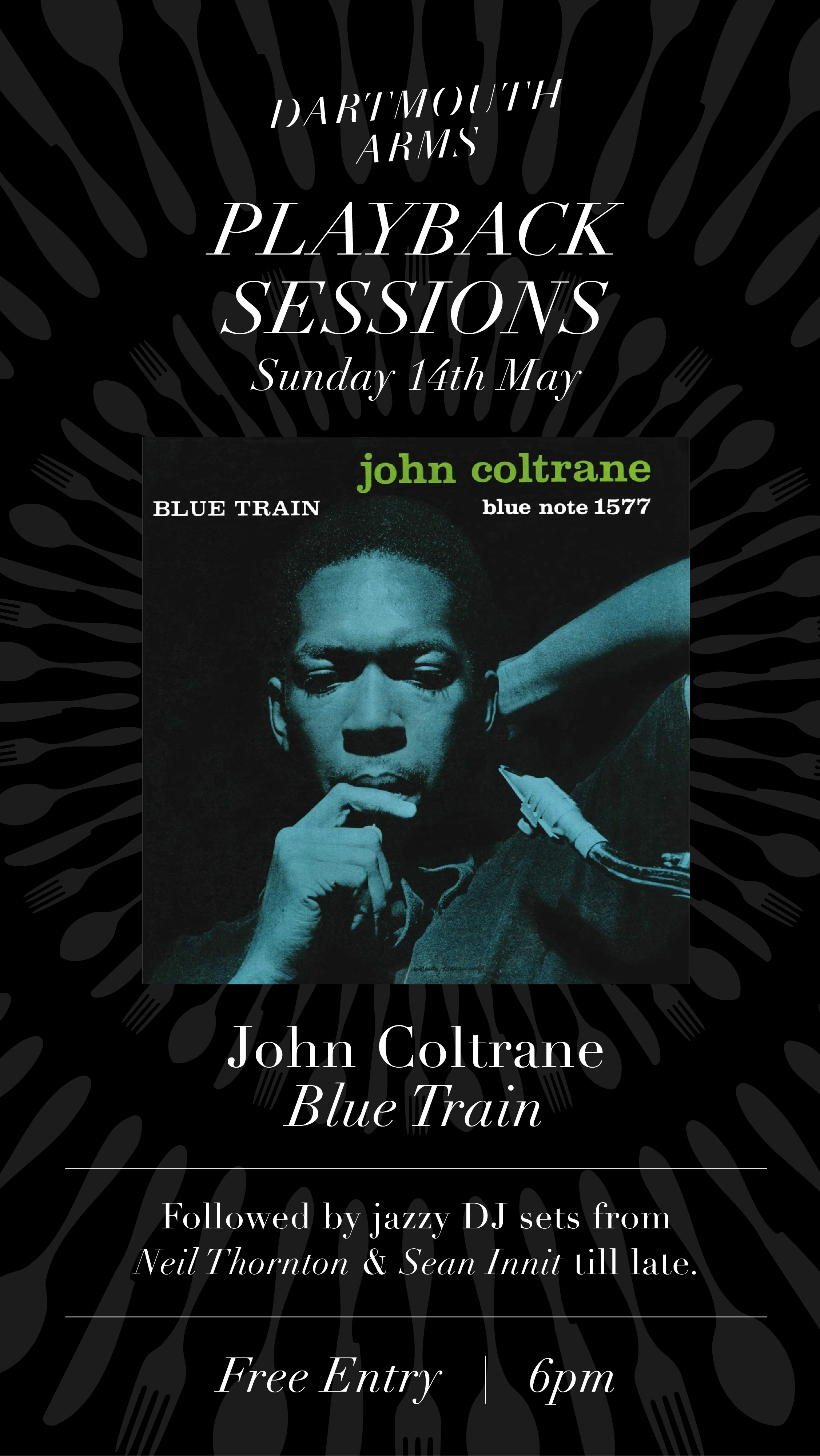
Sunday 14th May will be the last of my Playback Sessions at Dartmouth Arms NW5 for a while. I will be back later in the year and meanwhile there will be others carrying on the vinyl-only listening tradition. But the final one from me (for a bit) is a play-through of Coltrane’s Blue Note album Blue Train. That’s not to say we won’t dip into Crescent, My Favourite Things, A Love Supreme and so on. We will draw the line at the Ascension and Interstellar Space era. After all, we’d like people to stay. Blue Train, though, is hugely accessible and we are using the fantastic “Ultimate” version released last year. I’ll be in conversation with sax player Danny Silverstone of the Equinox Quartet (see https://mylifeinjazz.co.uk) , who will help steer us through Coltrane’s changes. As it says below, May 14, 6pm, free.
Joey DeFrancesco is very young to be a jazz legend. But legend he is. Mention the Hammond B3 organ to any jazz fan and three names will come up – Brother Jack McDuff, Jimmy Smith, who put the sound at the centre of soul-jazz in the 50s and 60s, and Mr D. “Well,” Joey says from home in the US, “I started young, that’s why people think of me alongside Jimmy or Jack. But I’m only 51,” he mock protests.
More music from the master of the B3
Starting young is right. He was four when he started playing the organ, nine by the time he could reach the foot pedals, although he was already playing in clubs alongside his musician father. He was such a keyboard prodigy that by 17 he was in Miles Davis’ band. Like many people who heard that husky voice on the line summoning them to New York, he thought it was friends spoofing him. “I must have hung up on him four times.”
But eventually he went to that terrifying audition where Miles pointed to the piano and said: “Play something for me.” So he did and he was in the group (this being the late eighties Tutu era). I asked if Miles had given him any advice. “Yeah. I was playing a solo one night and he wondered over and said: ‘Leave some holes.'” Miles being the master of space in a solo.
Joey had to leave, though. “I had done my own record by then and Columbia wanted me to go on the road to promote it. Miles was mad at first, but he understood.”
That first album and his subsequent ones, plus a punishing touring schedule, meant that Joey brought the Hammond back front and centre after a few years in the jazz doldrums. “There were some people who thought I was the first to play it in jazz. It was Fats Waller back in the early 40s who was the first in with Jitterbug Waltz! But it was sort of phased out for a while. You had synthesizers, which are way more portable, then bands like Weather Report with a very different sound, which I love, and rock bands had gone towards the piano. But the Hammond was still there. All I did was remind people how great it sounds.”
On his latest album – his 39th – More Music, Joey demonstrates he is more than just a keyboard whizz. He also plays trumpet and sax. Well. “When I was with Miles I was playing trumpet in secret. He was Miles, you know? But I played him one of his lines one day and he said: You sound like me. Do it again. So, I did and he said:Iit was better the first time. But he was very encouraging. He gave me some of his mouthpieces and a couple of Harmon mutes. I still miss him, man. The best times were when we weren’t on stage, just hangin’ out.” The trumpet is a hard mistress, but seeing Joey playing Hammond with one hand and trumpet with the other a few years ago, I couldn’t help thinking – that’s almost Miles I’m hearing, jamming from the after-life.
Joey’s new band, which features a second keyboard player/guitarist, which frees him to take sax solos, that again are remarkably adept considering he has only been playing a few years, will be at Ronnie Scott’s in a few weeks. Don’t worry, his obvious affection for other instruments will not overshadow what he is best known for – expect plenty of funky, gospely, soulful and swinging organ. In others words, the classic, compelling sound of a B3 in full flight.








 robtryan